I’ve backpacked my way through South America more than once, from trekking the Andes in Peru to hopping buses across Argentina and Brazil, and I can tell you firsthand that your backpack is more than just luggage. It’s your home, your office, and sometimes even your pillow. The right pack makes travel smooth, while the wrong one will have you cursing every cobblestone street and bus transfer.
After years of trial and error (and way too many broken zippers), I’ve figured out what really matters in a backpack for South America. I looked at comfort (because you’ll be carrying it for hours), durability (thin straps won’t survive Patagonia winds), size (big enough for gear, small enough to haul on local buses), organization (pockets you can actually use), and security (because crowded cities like Lima or Bogotá require extra peace of mind). These 12 backpacks stood out above the rest. They’re tested, trusted, and designed for the realities of South American travel…long treks, overnight buses, unpredictable weather, and everything in between.
What Changed in 2026
Osprey has discontinued the Airscape UNLTD, so it is off this list. In its place is the Pacsafe Venturesafe EXP45, a slash proof pack that fills the security gap the rest of this list left open. Everything else has been rechecked and still holds up.

Table of Contents
How to Choose the Best Backpack for South America
After backpacking across South America, I can tell you that your backpack will make or break your trip. I’ve had packs that felt like an extension of my body, and others that made every bus ride and border crossing a nightmare. Here’s what I look for when choosing the right one:
🛠 Durability Is Key
South America can be rough on gear…rocky trails in Patagonia, dusty streets in Bolivia, and crowded buses in Colombia will test every zipper and strap. I once had a cheap pack rip on me mid-trip, and I’ll never make that mistake again. Look for tough materials like ripstop nylon and reinforced stitching so your bag can take a beating.
🎒 Comfort Comes First
You’ll carry this pack a lot, sometimes for hours. I’ve done long treks in the Andes where the only thing that kept me going was having a bag with proper padding and adjustable straps. Make sure it has a solid hip belt and back panel that distributes weight evenly. Your shoulders will thank you.
📏 Size Matters
For South America, I’ve found the sweet spot to be 40–60 liters. It’s big enough to fit everything you need, but still small enough to lug onto buses, stash in hostel lockers, and carry comfortably through cities. On one trip I brought a 70L bag, and it was a nightmare on overnight buses and narrow hostel staircases.
🌦 Be Ready for Weather
From Amazon downpours to snowy mountain passes, the weather here changes fast. I always make sure my backpack is at least water-resistant, and I carry a rain cover that fits snugly. In Peru, a surprise downpour soaked almost everything I owned…except the gear inside my pack with a cover. Lesson learned.
🔒 Security Features
Crowded terminals, street markets, and long bus rides mean theft is a real concern. I prefer packs with lockable zippers, hidden pockets, and slash-resistant straps when possible. In Quito, I had a friend’s bag get unzipped on a busy bus. After that, I never traveled without lockable zippers.
Top Rated Travel Backpacks For South America
I’ve carried some terrible backpacks through South America, and the wrong one turns every bus terminal into a small argument with yourself. Here’s the full lineup at a glance, twelve packs sorted by what kind of traveler you are. Find yourself in the table and you can probably stop reading right there.
| Backpack | Best for | Capacity | Carry-on | Price |
|---|---|---|---|---|
| Osprey Farpoint Trek 55 | Best overall | 55L | No | $250 |
| Cotopaxi Allpa 42L | Best organization | 42L | Yes | $220 |
| Salkan Longhaul 45L + 20L | Best 2-in-1 | 45L + 20L | Some airlines | $515–545 |
| Osprey Atmos AG 65 | Best for trekking | 65L | No | $370 |
| Nomatic 40L Travel Bag | Best for city travel | 40L | Yes | $330 |
| Tropicfeel Shell | Best expandable | 20–42L | Yes | $239 |
| Osprey Aether Plus 70L | Best for expeditions | 70L | No | $450 |
| Osprey Aura AG 50 | Best women’s fit | 50L | No | $315 |
| Pacsafe Venturesafe EXP45 | Best anti-theft | 45L | Yes | $250–290 |
| Osprey Farpoint 40 | Best budget | 40L | Yes | $185–200 |
| Tortuga Travel Backpack Lite 40L | Best for long-term travel | 40L | Yes | $250 |
| Peak Design Travel Backpack 45L | Best premium one-bag | 30–45L | Yes | $299.95 |
1. Osprey Farpoint Trek 55
The Osprey Farpoint Trek 55 is the backpack I’d hand to almost anyone heading to South America. It carries like a proper trekking pack but opens like a suitcase, which means you get real suspension for the Andes without giving up easy access in hostel dorms. Very few packs manage both without feeling like a compromise.
At just under $250 it sits at the top of most people’s budget, though the build justifies it. The front-panel opening lets you reach anything in the bag without unpacking the whole thing, which matters when you’re living out of a top bunk. Hydration compatibility handles the trekking days, while the luggage-style layout keeps you organized the rest of the time.
The adjustable back panel is what makes this work for so many people. You can set the torso length yourself rather than hoping the pack fits, and one bag works whether you’re 5’6″ or 6’2″. The AirSpeed mesh panel holds the load off your spine and lets air move through, which you feel on humid Amazon trails and hauling it across Lima in the heat.
The included AirCover wraps the whole pack for check-in. This means baggage handlers can’t shred your straps, and it doubles as a rain cover on the trail. It’s kept my kit dry through more Andean downpours than I can count.
✈️ My #1 Tip for Cheap 2026 Flights:
It’s fall, which is the cheapest time to book flights. I’m currently seeing roundtrips to Europe for under $350 (deals you won’t find on Google Flights).
Step 1: Join Going.com's Free Plan here . It takes 10 seconds and requires no credit card.
Step 2: If you're doing a big trip this year, grab the 14-day free trial of Premium. You can even use my code JON25 for 25% off.
Seriously, this is the single best money-saving tool I’ve used in 10+ years.
👉 Send me cheap 2026 flightsAt 55 liters and 72cm tall this won’t fly as carry-on, so budget for hold luggage on internal flights. It swallows a multi-week kit while staying manageable on overnight buses and in hostel lockers. If you’re mixing trekking with regular backpacking, this is the one I’d buy again.
- Read next: Most Beautiful Places to Visit in Chile

2. Cotopaxi Allpa 42L
The Cotopaxi Allpa 42L is the best organized travel backpack for South America, and the one I recommend to anyone tired of digging through a top-loader. It opens flat like a book, with zippered mesh dividers splitting the main compartment into visible sections for clean clothes, dirty laundry, and gear. Nothing disappears into the bottom of the bag!
Cotopaxi revised the line, and the current version fixes the main complaints about the original. Shoulder straps and back panel got extra padding, weight distribution improved, and an external water bottle pocket finally appeared. At around $220 it costs more than the Farpoint, though you’re paying for organization rather than raw capacity.
The TPU-coated shell shrugs off abuse from South American bus roofs, boat decks, and the occasional Colombian downpour. Three grab handles mean you can haul it out of a bus hold from whatever angle you can reach. The bright colorways help when 30 identical black bags are piled at a terminal.
Two things to know before you buy. The laptop sleeve stops at 15 inches, ruling it out if you carry a 16-inch machine. Those mesh dividers also stretch rather than compress, and a fully packed bag can be a fight to zip shut.
At 42 liters and 22 x 14 x 11 inches it clears carry-on on most airlines. Plus, the lifetime warranty is worth having on a continent where repair shops are hit or miss. If you want your kit organized and findable, this beats everything else here.
- Read next: Wonderful Things to Do in the Amazon Rainforest
- You may also like: Mind-Blowing Places to See in South America

3. Salkan Longhaul 45L + Daypack 20L
The Salkan Longhaul 45L + 20L is the best two-in-one travel backpack for South America, and the one I didn’t expect to like as much as I do. You get a 45L main pack plus a detachable 20L daypack, which covers the way South American travel works: leave the big bag at your hostel, head out with just what you need. Buying a separate daypack always means compromising on fit, and this sidesteps that entirely.
Salkan reworked the range, and pricing moved with it. The Longhaul 45L on its own is $380, while the bundled 45 + 20L set lists at $545 and often drops to around $515. It’s the priciest thing on this list, though you’re getting two bags and a lifetime repair guarantee.
The main pack expands from 35L to 45L and opens from the top or through a full front panel, which is brilliant for grabbing one thing without unpacking your whole life. The recycled fabric has a wax coating that handles rain on its own, no separate cover needed. My friend’s pack has been through some grim Patagonian weather and everything inside stayed dry,
The daypack is where this system earns its money. It’s a real bag with a padded laptop sleeve and enough structure for a day hike. You can use it for Machu Picchu day trips, wandering Buenos Aires, and as a personal item on flights.
Two honest downsides. At 2.1kg the main pack is heavy for its size, and the waxed finish is part of why. At 66cm tall it also busts strict carry-on limits, and you should plan on checking it with budget carriers.

4. Osprey Atmos AG 65
The Osprey Atmos AG 65 is the best trekking backpack for South America, and the gold standard if you’re planning to spend time in the mountains. At $370 it’s a big investment, though the carrying comfort is unmatched at this capacity. Osprey updated the pack recently and fixed most of the small complaints people had with the old version.
The AntiGravity suspension sounds like marketing nonsense until you carry it. The tensioned mesh back panel runs continuously into the hipbelt, holding the load off your spine and spreading it across your whole torso. I’ve carried this loaded with 40+ pounds through the Andes and forgotten how much was in it.
The mesh panel also keeps your back off the pack itself, which is a relief in humid places like the Amazon basin. The update brought extra hipbelt padding, better access to the main compartment, and a rain cover included in the box. Curved side zips let you reach mid-pack layers without unpacking from the top.
At 65 liters this is far too big for city travel and won’t go anywhere near an overhead bin. It’s built for Torres del Paine circuits, multi-day Amazon expeditions, and Andean climbing trips. The zippered sleeping bag compartment and removable divider make organizing camp gear straightforward.
Two things to weigh up. At over 4.5 pounds it’s heavy for its class, and the hipbelt takes a few days to settle into. Osprey’s lifetime repair guarantee covers the pack forever, which counts for a lot on a continent where finding a gear shop is luck.
- Read next: Breathtaking Places in Patagonia

5. Nomatic 40L Travel Bag
The Nomatic 40L Travel Bag is the best travel backpack for cities in South America. It’s built for Buenos Aires, Santiago, and Bogotá rather than the trail. At $330 it’s expensive for a 40L pack, though nothing else here comes close on organization. This is the bag for people who want everything in its own designated place.
There are more than 20 pockets and compartments inside. Dedicated spaces exist for tech, liquids, and shoes, and the laptop compartment swallows a 16-inch machine with room for a tablet. Check the listing before you buy, since sizing varies between versions.
The tarpaulin shell and sealed zippers shrug off heavy rain without a cover, useful in Colombian downpours and on wet bus roofs. It converts between backpack and duffel, and I use duffel mode for flights and switch to straps for walking around cities. Removable waist straps help when it’s fully loaded.
At 21 x 14 x 9 inches it clears carry-on limits on most airlines. The included laundry bag keeps dirty clothes separate when you’re moving every few days. Plus, the RFID-safe pocket is worth having in crowded markets and terminals.
There’s two drawbacks with the Nomatic 40L. It’s heavy for a 40L bag, and the rigid structure means you can’t stuff it past its limits the way you can with a soft-sided pack. All that internal organization also eats into open space, which makes bulky items like a sleeping bag awkward. This is an urban pack, and it doesn’t pretend otherwise.

6. Tropicfeel Shell
The Tropicfeel Shell starts as a 20L daypack and expands to 42L with the full accessory system. Your needs change constantly in South America, and having one bag that covers a Cusco day hike and a two-week overland stretch solves a problem. Loosening the top flap buckles gets you most of that extra volume in seconds.
The expansion happens a few different ways. That top flap has more slack than you’d expect, the wardrobe insert adds structure for longer trips, and a kangaroo pouch at the base contributes another 6L. Toiletry and tech pouches clip to the front on magnetic locks that stay put until you deliberately pull the tab.
DWR treatment shrugs off light rain and dusty Bolivian bus rides, though I wouldn’t call this a waterproof pack. The updated version came down to 2.74 pounds from 3.3, and you notice the difference on long walking days. The ergonomic back panel and removable hip belt keep it comfortable even fully expanded.
Most of that headline capacity lives in the accessories, and buying into the system properly pushes the real cost well past the sticker price. Tropicfeel also sells a Shell 1.0 and a lighter ProLite alongside the standard Shell, and it’s easy to order the wrong one without checking carefully. Skip this if you’re planning serious wilderness trekking, but for moving between cities, buses, and the odd trail day, the flexibility is hard to beat.

7. Osprey Aether Plus 70L
The Osprey Aether Plus 70L is serious overkill for most people, but if you’re planning extended wilderness expeditions in South America, this is the pack that can handle it. At $450, it’s the most expensive pack on this list by a clear margin.
The Custom Fit-On-The-Fly hipbelt and shoulder straps adjust to your torso, and you can tune them on the trail without taking the pack apart. High-tenacity nylon handles rocks, scree, and being dragged onto bus roofs. I’ve used this on multi-week trips where comfort mattered more than anything else, and it delivers.
The top lid detaches and converts into a full daypack, which saves you carrying a second bag for summit pushes and day hikes from a base camp. Exterior storage is generous, and you can strap gear to the outside when the inside is full. The integrated rain cover and hydration compatibility are both standard.
At 5 lbs 9.7 oz empty this is heavy before you put anything in it, and that weight goes into the suspension rather than being wasted. Osprey’s lifetime repair guarantee is worth having on a pack you plan to own for a decade. I’d definitely skip this for city travel or hostel hopping, where 70 liters becomes a burden on buses and a nightmare in dorms.
- Read next: Enchanting Spots in the Andes Mountains

8. Osprey Aura AG 50
The Osprey Aura AG 50 is built specifically for women, and the difference shows up over long carrying days. Shoulder straps, hipbelt, and back panel are all shaped for narrower frames and different torso proportions. My wife switched from a unisex pack and noticed the difference within a day.
AntiGravity suspension wraps a continuous panel of 3D mesh from your shoulders down into the hipbelt. It spreads the load across your whole body rather than dumping it on your shoulders, and the mesh keeps the pack itself off your back. That ventilation counts for a lot in humid Amazon heat and on sweaty Andean climbs.
At 50 liters there’s room for camping gear without the bag becoming unwieldy on buses or in hostels. Curved zips on both side panels let you reach mid-pack layers without unloading from the top. The raincover is included and has held up through Patagonian storms.
Fit is the thing to get right here, and it’s worth trying before you commit. The pack comes in XS, S, and M, though women with petite frames have found the hipbelt sits wrong even at its tightest setting. Osprey’s lifetime repair guarantee applies whatever happens, and if you travel light, the Aura AG LT 50 is a lighter alternative at $270.

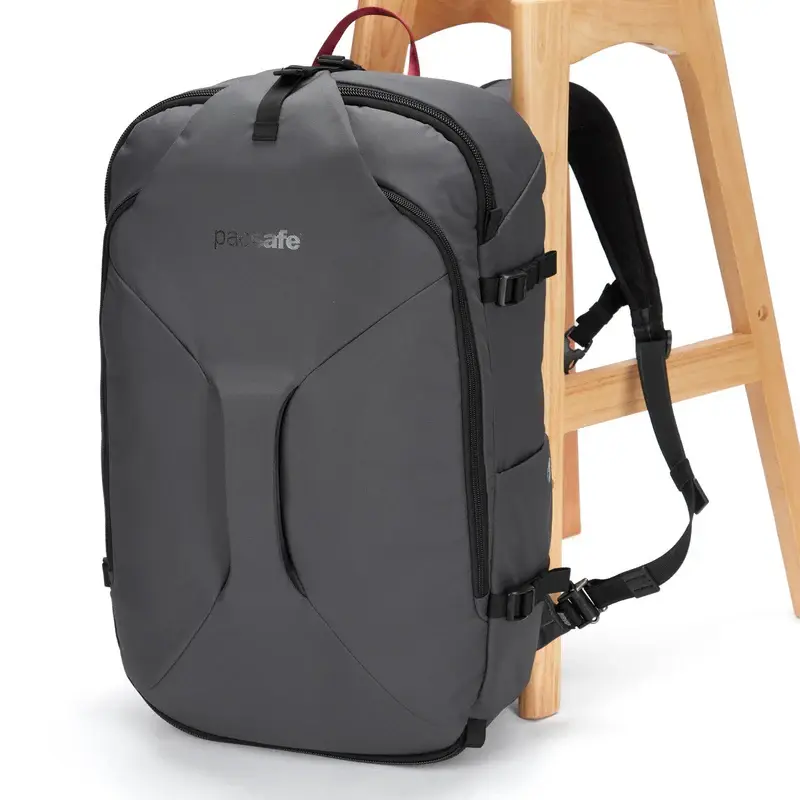
9. Pacsafe Venturesafe EXP45
The Pacsafe Venturesafe EXP45 is the one I’d point you to if theft is what keeps you up at night. Bag slashing and grab-and-runs are a real thing on South American buses and in crowded terminals, and this pack was built for exactly that. It costs between $250-$290 depending on where you buy and whether you catch a sale.
The security here goes well beyond a padlock. A flexible steel mesh is woven into the fabric itself, meaning a knife won’t get through the bottom of the bag, and the zippers resist being punctured with a pen. The straps have the same slashguard treatment, and a steel cable lets you lock the whole thing to a bed frame or bus rack.
The RFID-blocking pocket keeps your passport and cards safe in crowded markets, and the locking system hides under a top flap rather than announcing itself. Nothing about this pack looks tactical or expensive, which is half the point. It stays a plain black bag that nobody looks at twice.
At 45 liters and 21.7 x 13 x 7.5 inches it clears carry-on on most airlines, and the straps stow away when you want to carry it like a duffel. The 750D recycled polyester has a water-repellent coating that handles rain, though the zippers aren’t weather-sealed at this price. Getting into a locked bag takes a few extra seconds, and that’s the trade you’re making.
10. Osprey Farpoint 40
The Osprey Farpoint 40 is probably the most popular travel backpack on the planet, and for good reason. You’ll see dozens of them in any South American hostel, and the reason is simple. It does 90% of what pricier packs do for a fraction of the money.
Two versions are floating around right now. The older model sells for about $185 and shows up heavily discounted on clearance, sometimes near $100. The 2026 refresh costs $200, uses slightly thinner fabric, and moves the laptop sleeve and bottle pockets around. Both are good. If you find the outgoing version cheap, I’d take it.
At 40 liters it clears carry-on limits at 22″ x 14″ x 9″, saving you baggage fees on the budget carriers you’ll be flying between Lima, La Paz, and Santiago. The clamshell opening lays the whole pack flat for easy packing in a cramped dorm. Lockable zippers add a layer of security for bus storage and hostel lockers.
The AirScape suspension borrows from Osprey’s hiking line, with a framesheet and peripheral frame that shift weight onto your hips rather than your shoulders. I’ve walked hours through Quito with it loaded without any real complaints. The laptop sleeve takes a 16″ machine and now sits flat against the back panel, which improves both protection and balance.
Organization is basic next to urban packs like the Nomatic, and the fabric feels lighter than it did five years ago. Neither of those things will ruin your trip. With Osprey’s All Mighty Guarantee covering repairs for life, it’s the best value pack on this list.
- Women’s fit: the Fairview 40 is the same pack on a shorter torso, same price.

11. Tortuga Travel Backpack Lite 40L
The Tortuga Travel Backpack Lite 40L at $250 is perfect for digital nomads living out of one bag through South American cities. It’s a full pound lighter than the Tortuga Pro and a hundred dollars cheaper, with the same 40 liters of space. When you’re carrying everything you own for months, that pound makes a difference.
Tortuga got the weight down by stripping things out. There’s no admin panel and no layered pockets, just one big open interior that opens flat like a suitcase. I love this if you already pack with cubes, though if you want a designated slot for every cable, the Nomatic handles that better.
The hip belt is the standout feature here. It takes 80% of the weight off your shoulders, and you feel it walking from a bus terminal to your hostel with a full load. The 630D CORDURA shell is tough and scuffs rather than tears, which is what you want after a few months of bus roofs and hostel floors.
At 22 x 14 x 8 inches it clears carry-on on both US and international airlines, including the budget European carriers. One thing to check before you buy: it fits 19-21 inch torsos with no height adjustment, and the Pro is the better call if you’re outside that range. External storage is minimal too, with just a side pocket, a top pocket with key leash, and a bottle sleeve.
For working travelers spending months in cities like Buenos Aires, Santiago, or Medellín, this is the pack I’d point you toward. The build quality is excellent and Tortuga stands behind their products. If you want comfort and durability without paying premium prices, it’s the best value here.
- Read also: The Best Hidden Gems in South America
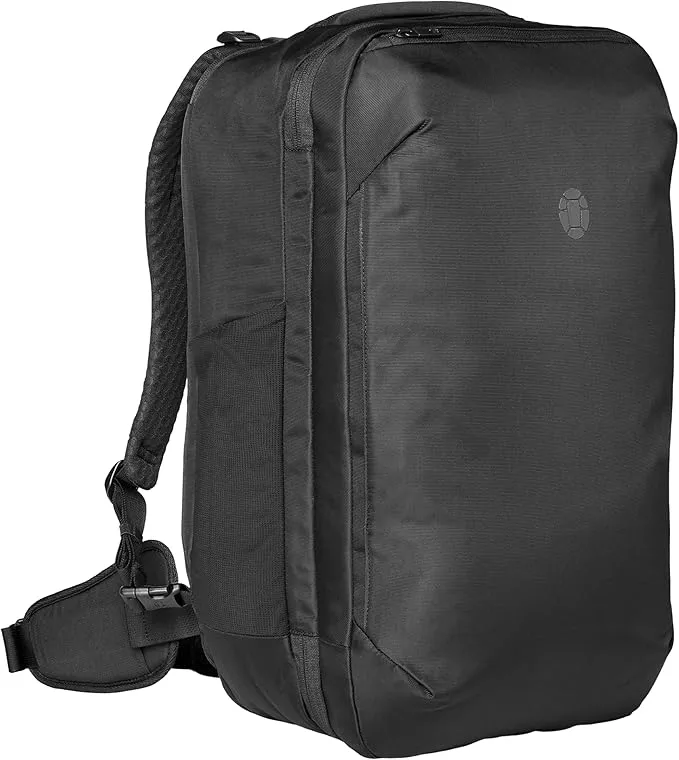
12. Peak Design Travel Backpack 45L
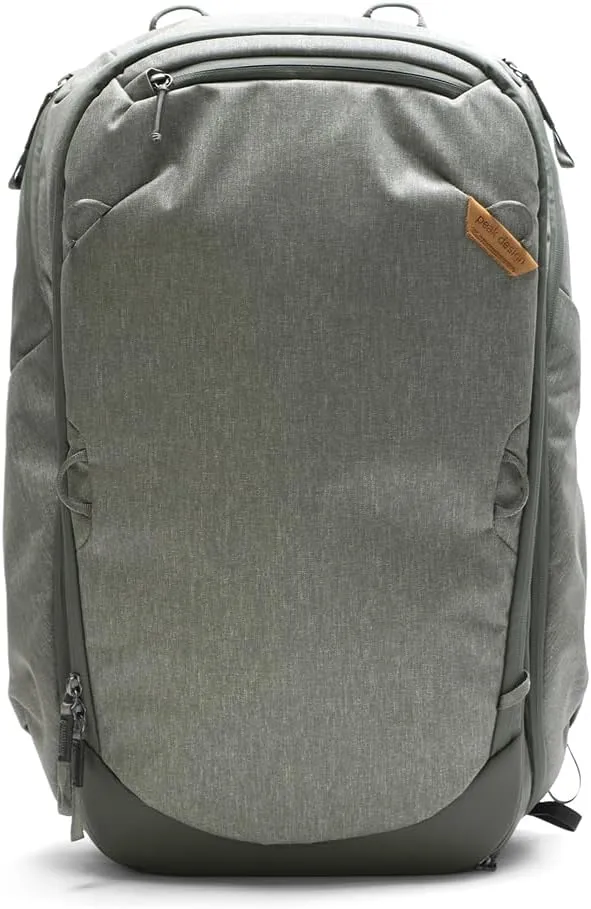
The Peak Design Travel Backpack 45L is the best premium one-bag option for South America, and the one to buy if you carry a camera. At $299.95 it’s expensive, though you’re buying a pack that adjusts from 30L to 45L depending on the trip. Compression snaps shrink it down, expansion zips open it up, and it sits at 35L the rest of the time.
Access is where it beats everything else on this list. You can get in from the top, both sides, the front, or fold the whole back panel open like a clamshell. That means grabbing a jacket from a bus overhead rack without unpacking, or pulling a camera out fast when something’s happening in front of you.
The 400D nylon shell holds its shape even half empty, and the 900D waterproof bottom liner means setting it down on a wet Patagonian platform won’t soak your gear. The laptop sleeve fits a 16-inch machine and sits where you can reach it at airport security. Camera cubes slot straight in if you shoot seriously.
Straps stow behind magnetic panels when you want to carry it by the handle or throw it on a bus rack. At 4 lb 8 oz it’s heavy for 45 liters, and all that hardware is part of why. It also carries less comfortably than the Osprey packs over long distances, and this is a pack for airports, taxis, and cities rather than multi-day treks.
FAQs About Travel Backpacks for South America
Check out my FAQ section to find answers about cool backpacks that will make your trip even better.
How do I keep my backpack safe from theft in South America?
Opt for a backpack with security features like lockable zippers and hidden pockets. Many travel backpacks come equipped with RFID-blocking materials to protect your cards and passports. When traveling, it’s also smart to use luggage locks and to keep your backpack in sight or secure it to immovable objects when sitting down.
Is a backpack better than a suitcase for traveling in South America?
In many cases, yes. Backpacks offer more flexibility and are easier to carry on various terrains and through crowded areas, which is typical in South America. They are also better for areas where you might find uneven paths or cobblestone streets, unlike suitcases which can be cumbersome to roll.
Can you recommend a backpack that is good for both hiking and city touring in South America?
Certainly! Look for a backpack that is around 40 to 50 liters with features suitable for both city touring and hiking. It should be robust enough to handle outdoor wear and tear but sleek enough not to be cumbersome in urban environments. Features like a padded laptop compartment and a hydration reservoir compatibility are also beneficial for such versatile use. This will come in handy in cities like Bogota and Buenos Aires to nature spots in Patagonia.
Global Viewpoint is a personal blog. All content is for informational and entertainment purposes only and does not constitute professional financial, medical, or legal advice.