Iberia has some significant changes coming in 2026 that business class travelers should know about. I’ve been tracking their expansion closely, and there’s genuine value here. They’re introducing new routes across North America, more of their newest A350 suites with doors, and a dedicated premium lounge opening in Madrid. The award pricing still starts at 40,500 Avios, which makes it one of the better deals for crossing the Atlantic.
I’ve flown Iberia business class multiple times, and this guide is my honest take on what it’s like in 2026. I’ll walk you through what’s new, which aircraft to aim for, and when it’s worth booking, whether you’re paying cash, using Avios, or jumping on a deal. If you’re debating whether to fly Iberia for your next trip to Spain or Latin America, this is everything I’d want to know before booking.
Toronto Route Launches June 13, 2026
Iberia’s first-ever route to Canada starts this week. Madrid to Toronto (YYZ) begins June 13, 2026 with five weekly flights on the A321XLR, the same single-aisle jet with the 1-1 business cabin I covered above. If you’re flying from Toronto, the schedule just opened, so this is the route to watch for award space. See Iberia’s announcement.
My 2026 Snapshot: Is Iberia Business Class Worth It?
If you are short on time, here’s some info on the current fleet and pricing sweet spots for 2026. The most critical thing to know is that not all Iberia Business Class seats are equal, even if the price is the same.
Fleet & Seat Cheat Sheet
Use this table to check your aircraft type (listed on your booking) against the experience you’ll actually get.
| Aircraft Type | Seat Layout | Privacy & Comfort | Verdict |
| Airbus A350 “Next” | 1-2-1 (Suites) | High. Features closing doors and 4K screens. | ⭐⭐⭐⭐⭐ (Target this) Look for middle seats in Row 11 (Premium Eco) on the seat map to confirm. |
| Airbus A350 (Old) | 1-2-1 (Open) | Medium. Direct aisle access but exposed. | ⭐⭐⭐⭐ (Solid) Standard lie-flat experience. Good for couples. |
| Airbus A321XLR | 1-1 (Herringbone) | High. Solo seats only. Newest tech. | ⭐⭐⭐⭐ (Unique) Great for East Coast solo flyers; avoid if you dislike narrow planes. |
| Airbus A330 | 1-2-1 (Dated) | Low. Older screens and wear & tear. | ⭐⭐⭐ (Average) Fine for sleeping, but aim for newer planes if paying cash. |
💰 The “Sweet Spot”:
The best value redemption right now is 40,500 Avios (Off-Peak) from Boston, New York (JFK), or Chicago to Madrid, after Iberia’s March 2026 award repricing (it sat at 34,000 for years). Taxes are typically under $130.
Now that you know which plane to look for, here is my top strategy for finding the cheapest cash fares when you can’t use points.
Overview of Iberia
Iberia has been Spain’s flagship carrier since 1927. Based out of Madrid, they fly to 138 destinations across 49 countries, which is impressive coverage. I’ve flown with them multiple times. What always strikes me is how they manage to feel both professional and distinctly Spanish at the same time.
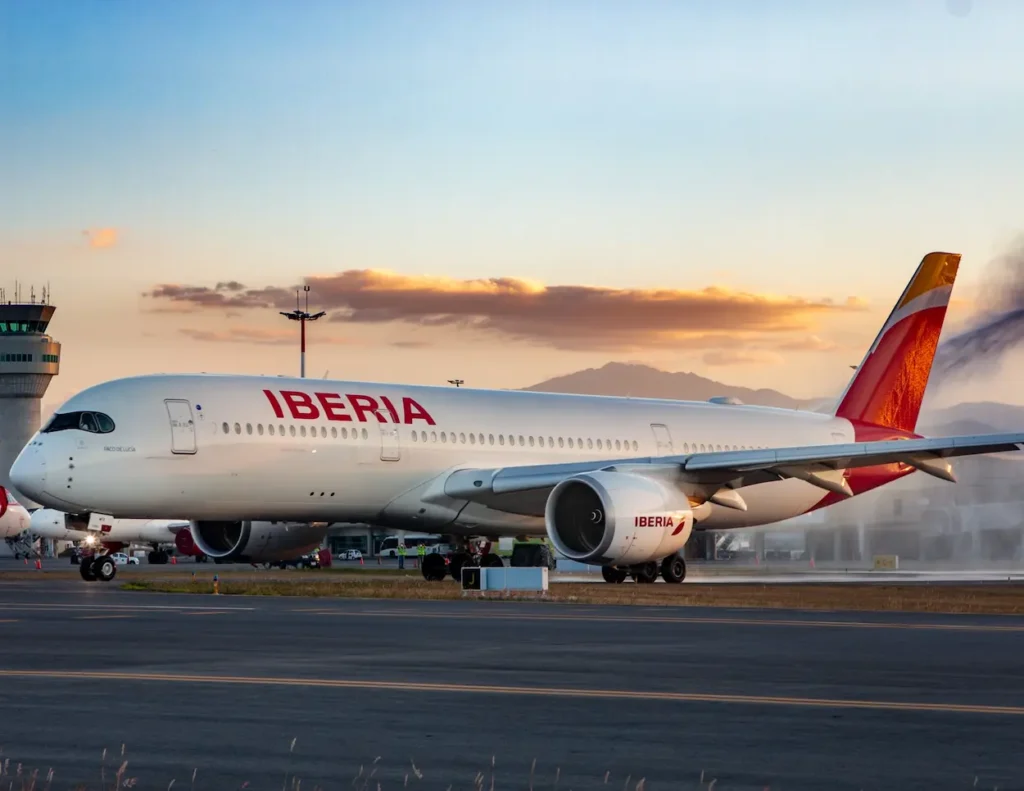
Their fleet currently sits at around 95 aircraft. Iberia were the first airline in the world to operate the new Airbus A321XLR. I flew one of these to Boston earlier this year, and it’s fantastic for long-haul routes They’re using these for flights to Boston, Washington D.C., and expanding to more North American cities. This means you can fly transatlantic on a single-aisle plane that still has proper lie-flat business class seats.
Being part of the Oneworld alliance is a huge plus. It means your lounge access and elite benefits work globally, not just on Iberia flights. The connectivity through Madrid is genuinely convenient if you’re heading to Latin America. They have one of the strongest networks between Europe and South America.
- Read my guide: The Best Airlines from the US to Europe in 2026

What’s new with Iberia business class in 2026?
If you’re planning to fly business class to Europe in 2026, Iberia deserves your attention. They’re launching six new North American routes, expanding their premium lounge offerings in Madrid, and rolling out more of their newest business class suites. Here’s what’s actually changing.
The A350 “Next” suites are expanding
Since late 2022, Iberia has been rolling out A350 “Next” business class suites with closing doors on eight newer aircraft. I flew one of these cabins to Bogotá last spring, and it’s a real upgrade. The Recaro seats offer better privacy, and the wood-effect console tables look fantastic.
Both cabins look nearly identical on the seat map, which is frustrating. Here’s how to tell them apart: check the premium economy section. If row 11 has middle seats, you’re on a “Next” aircraft with the doored suites. Window seats 5L and 7L are still the best for privacy.
✈️ How I Fly for a Fraction of the Price (Even Business Class)
Airfare keeps climbing, but I almost never pay full price. Going.com emails me roundtrips to Europe for under $350. With Elite, you’ll even see business class to Europe for ~$1,700 (deals you won’t find on Google Flights).
Planning a big trip? Elite members save up to $2,000 on a single international business-class ticket. I’ve seen nonstop biz to Scotland for $1,250.
👉 Try Going Elite free for 14 days. Cancel anytime, and use code JON25 for 25% off.
Just want the cheap economy deals? Start free in 10 seconds, no credit card required.
It’s the best money-saving tool I’ve used in 10+ years of travel.
👉 Try Going Elite free →Six major new routes to North America
Iberia is making Madrid a genuine rival to other European hubs. Toronto launches June 13, 2026, with five weekly A321XLR flights, Iberia’s first-ever route to Canada. This follows recent launches to Orlando and upcoming service to Recife and Fortaleza in Brazil. Philadelphia is confirmed but doesn’t have dates yet. They’re also looking at more San Francisco flights and other East Coast cities within A321XLR range.
The A321XLR keeps expanding
Iberia was the world’s first airline to fly the A321XLR, and they’re all-in on it. The plane saves them 40% on fuel compared to widebody aircraft. This means better fares for us and year-round service on routes that would otherwise be summer-only.
The 14-seat business cabin has the Thompson VantageSOLO seat in a 1-1 configuration. Every seat gets direct aisle access, even on a single-aisle plane. I’ve flown it to Boston, and yes, nine hours on a narrowbody feels different, but everything is brand new and the seat goes fully flat.
A new premium lounge is coming to Madrid
Iberia is opening a third lounge at Madrid Terminal 4 for Oneworld Emerald members by early 2026. It’ll be in the main T4 terminal between the Dalí lounge and Puente Aéreo. I’ve been in the Dalí lounge when it’s packed during peak hours, and it’s miserable. This dedicated premium lounge should fix that problem.
Fleet expansion and cabin refurbishments
Iberia is expanding its long-haul fleet from 45 to 70 aircraft by 2030. They’re also retrofitting older A330s with the latest business class product, so you won’t get stuck with outdated seats.
Award space is still available
Business class awards from the US to Madrid start at 40,500 Avios one-way during off-peak periods. I’ve booked several of these over the past year. With all the new routes and aircraft coming online, there should be decent availability in 2026 if you book when the schedule opens.
Best and worst Iberia planes for business class
Not all Iberia business cabins are the same. Most long-haul flights have lie-flat seats with direct aisle access, which is the baseline. But some aircraft are significantly better than others. Here’s how to choose.
Best: A350-900 with “Next” suites (doors)
If you can get on an A350 with the newer “Next” suites, you’re in the best seat Iberia offers. These have closing doors, the Recaro CL6720 seat, 4K screens with Bluetooth, and wood-effect console tables that look much better than the all-grey older cabins.
I flew one of these earlier this year, and the privacy makes a real difference. The doors create a proper suite feel. If you’re flying solo, I recommend seats 5L and 7L. These give you maximum privacy and are located right by the window.
How to spot them: check the premium economy section on the seat map. If row 11 has middle seats, you’re on a “Next” aircraft. Iberia currently has eight of these, flying mostly to Latin America. Buenos Aires, Bogotá, Mexico City, and Lima get them regularly.
Very good: A350-900 (older version, no doors)
The older A350s don’t have doors, but they’re still a strong product. They feature the same 1-2-1 layout with direct aisle access and fully flat beds. I’ve slept well on these flights. They just don’t have the “wow” factor of the newer cabins. You’ll find these on flights to New York, Los Angeles, and some Latin American cities. Still a solid choice, especially if you’re booking with Avios.
Good: A330-300 and A330-200
These are the workhorses of the fleet. Same 1-2-1 layout with direct aisle access, but the cabins feel more dated. The seats are comfortable enough to sleep on, but the overall experience is less polished than the A350s.
The A330-300 has 29 business class seats, and the A330-200 has 19. You’ll see these on routes like Miami, Boston, and some South American destinations. Totally fine if the price is right or you’re using miles, but I’d try to avoid them if paying full cash fares.
Interesting option: A321XLR
This is Iberia’s newest aircraft, and I’m a big fan. It’s a single-aisle plane with 14 business class seats in a 1-1 configuration using the Thompson VantageSOLO seat. Every seat gets direct aisle access, and everything is brand new.
I flew this to Boston, and it’s better than expected. Yes, it’s a narrowbody for a transatlantic flight. But the seat goes fully flat, and it’s superbly comfortable. It’s currently flying to Boston and Washington D.C., with Toronto launching in June 2026. The trade off is that the cabin is smaller, aisles are narrower, and galley space is tight so service can feel rushed. But it’s still a proper business class experience.
Skip: Short-haul A319/A320/A321
For flights within Europe, Iberia uses standard economy cabins where they just block the middle seat in business class. You don’t get lie-flat seats, premium amenities, or special meals. It’s fine for a two-hour flight, but don’t expect a long-haul business class experience.
How to book Iberia Business Class for less
Iberia business class doesn’t have to drain your bank account. If you’re flexible and know where to look, there are reliable ways to bring the cost down.
1. Use Avios (and understand the sweet spots)
Iberia uses a distance-based award chart, which creates some excellent deals. Business class from Boston, New York, or Washington D.C. to Madrid starts at 34,000 Avios one-way during off-peak periods. Chicago also prices at 34,000 Avios despite being slightly farther. Longer routes like Miami or Los Angeles start at 42,500 Avios.
Off-peak dates cover most of the year except summer (late June through mid-September), winter holidays, and a few scattered dates. Taxes and fees are reasonable, usually around $125 one-way. The value is hard to beat, especially when you see cash fares running $2,000-$3,000 one-way.
2. Transfer credit card points strategically
Avios can be earned through several credit card programs that transfer instantly.
- American Express Membership Rewards → Iberia Plus or British Airways (1:1)
- Chase Ultimate Rewards → Iberia Plus or British Airways (1:1)
- Capital One → British Airways (1:1)
- Citi ThankYou → Iberia Plus (1:1)
- Bilt Rewards → British Airways or Iberia Plus (1:1)
The beauty of this system is that you don’t need to speculatively transfer points. Search for award space first, confirm availability, then transfer only what you need. Transfers are usually instant.
3. Book through British Airways Executive Club instead of Iberia Plus
British Airways and Iberia charge the same number of Avios for Iberia flights, but the BA website is more user-friendly and customer service is generally better. You can freely move Avios between the two programs at 1:1, so there’s no downside to booking through BA if you find it easier.
One quirk: if you’re searching on American Airlines’ website (which shows Iberia award space), you might only see one business class seat even when two or more are available. This seems to be an intentional restriction. Use AA.com to identify dates with availability, then check British Airways or Iberia directly to book multiple seats.
4. Book early when the schedule opens
Iberia typically releases 1-2 business class award seats when the schedule opens, roughly 330 days out. Once those seats are booked, they often don’t come back until close to departure (if at all). British Airways can search Iberia flights about a month further out than American Airlines, which gives you a slight advantage.
✈️ How I keep catching Iberia business class to Madrid under $1,600
Cash fares on this route normally run $2,000 to $3,000 one-way, but I booked a roundtrip to Madrid for $1,600 last year after Going Elite flagged the drop. On the transatlantic business cabins I cover above, I’ve seen fares fall 40-60% below what Google Flights shows. If you can’t make the Avios sweet spot work, this is how I catch the cash deals instead.
Try Going Elite free for 14 days — use code JON25 for 25% off if you keep it.
5. Consider paid upgrades if you’re flexible
If you’ve already booked economy or premium economy, Iberia sometimes offers paid upgrades at check-in or via email before departure. These aren’t guaranteed, but they can be cheaper than booking business class outright if availability opens up last minute.
Ground experience: check-in, lounges and getting through Madrid
One thing I appreciate about flying Iberia business class is that the experience starts well before you board. Madrid is their home base, and they’ve invested in making the ground experience smooth.
Check-in and priority services
With a business class ticket, you get dedicated check-in counters and priority security. At Madrid, this makes a big difference. Terminal 4 is massive and beautifully designed (Richard Rogers architecture), but the distances you cover can be long. Priority security cuts the wait significantly, and I’ve never spent more than 10 minutes getting through. At other airports, Iberia uses the standard Oneworld priority lanes.
Velázquez lounge (Terminal 4S, for non-Schengen flights)
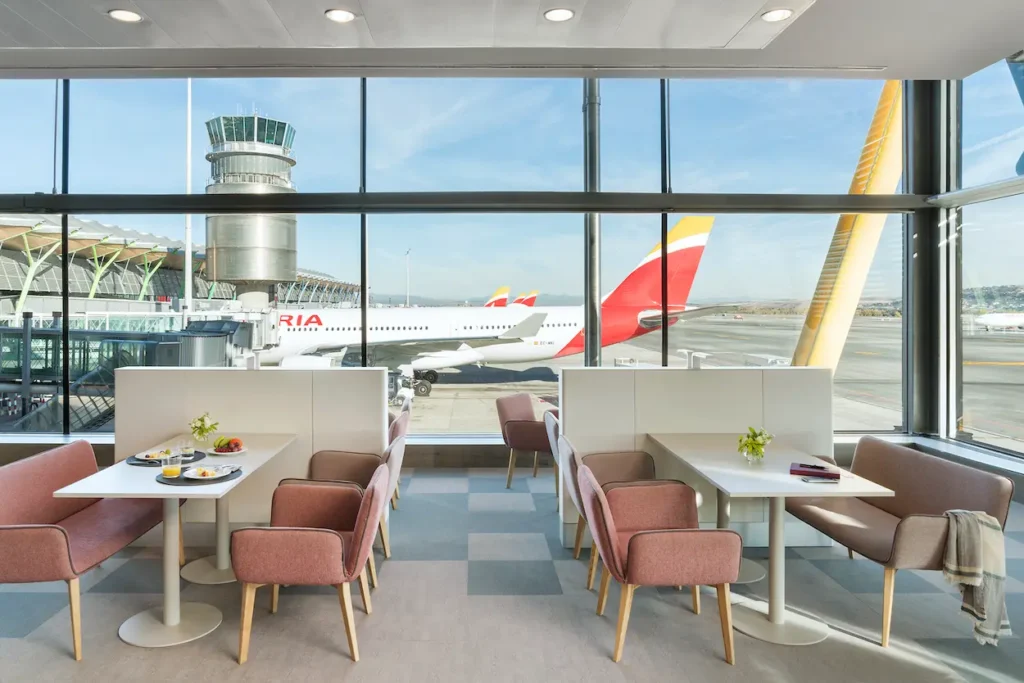
Iberia operates two main lounges at Madrid, and which one you use depends on where you’re flying. The first is the Velázquez lounge, which is located in Terminal 4S. This is Iberia’s flagship lounge and where you’ll be if you’re flying to the US, UK, or anywhere outside the Schengen zone. The lounge is long and narrow, stretched along the satellite terminal with massive windows overlooking the runways.
I’ve been through here multiple times, and the views alone make it worth arriving early. The lounge has a wine bar (though it’s not always staffed), multiple food stations, showers, and a dedicated dining area that opens around 7:30 PM for Latin American departure waves.
The food is hit or miss. Breakfast is good with fresh fruit, yogurt, and hot items. Lunch and dinner can be underwhelming. The drinks selection is excellent though, with Spanish wines, Mahou beer, and proper Lavazza coffee from barista stations. Showers are clean and readily available.
Dalí lounge (Terminal 4, for Schengen flights)
If you’re flying within Europe, you’ll use the Dalí lounge in the main terminal. It’s been recently renovated and now offers 2,000 square meters with 455 seats. The Dalí lounge is bright, airy, and less crowded than Velázquez during peak times. It has the same amenities: showers, food stations, coffee bars, and a kids’ play area. I actually prefer Dalí when I’m connecting through Madrid on a Schengen flight. It’s quieter and the food offerings seem fresher, though that might just be timing.
The new Emerald lounge (coming 2026)
Iberia is opening a third lounge in Terminal 4 specifically for Oneworld Emerald members. It’ll be between the Dalí lounge and the domestic shuttle gates, not out in the satellite terminal. This should help with overcrowding during peak hours, especially with all the Latin American traffic that runs through Madrid.
Lounges outside Madrid
At other airports, Iberia uses partner lounges or contracts with third parties. At New York JFK, business class passengers use the Greenwich Lounge in Terminal 8. It’s fine but nothing special. Other US airports vary. Sometimes you’ll get an American Airlines Admirals Club, which is decent but not on par with what Iberia offers in Madrid.
Getting through Madrid on connections
Madrid Terminal 4 is stunning but sprawling. If you’re connecting, give yourself time. The train to the satellite terminal (T4S) takes a few minutes, and immigration for non-Schengen flights can back up during peak hours. I’ve seen waits over an hour for non-EU passport holders.
The good news: if you’re staying within Schengen or connecting to another long-haul flight, the process is usually smooth. Security is efficient with priority lanes, and the lounges are genuinely somewhere you’ll want to spend time rather than just killing time before boarding.
- Read next: Best Airlines to Spain
Onboard comfort: seats, sleep, Wi-Fi and amenities
Once you’re on board, Iberia business class is comfortable and has a distinctly Spanish feel. Your experience depends heavily on which aircraft you’re flying.
Seats and layout
Most long haul routes use a 1-2-1 configuration with fully flat beds and direct aisle access. The newer A350s with doors (Iberia calls them “Next Generation”) are the ones you want. These feature sliding doors, cleaner grey and beige design with red accents, and good privacy.
The A330s and older A350s have the same layout but no doors. They’re still comfortable for sleeping, just less modern and more exposed. If you’re booking these, go for window seats (rows A and L) for the best privacy. The center “honeymoon” seats in odd rows (E and G) work great if you’re traveling with someone – they’re close together with just a low divider.
The A321XLR is completely different. Just 14 business class seats in a 1-1 configuration, herringbone style with your head at the window. It’s impressively modern for a narrowbody, but everything does feel tighter than a widebody plane.
Sleep and bedding
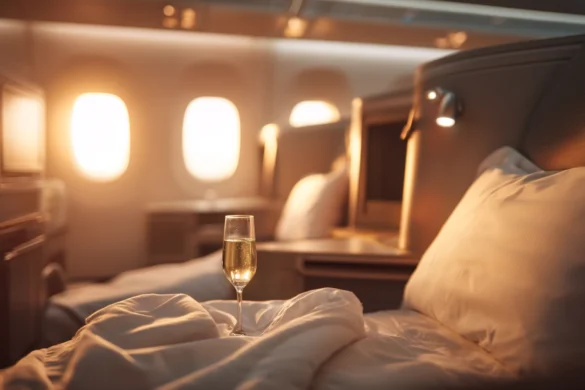
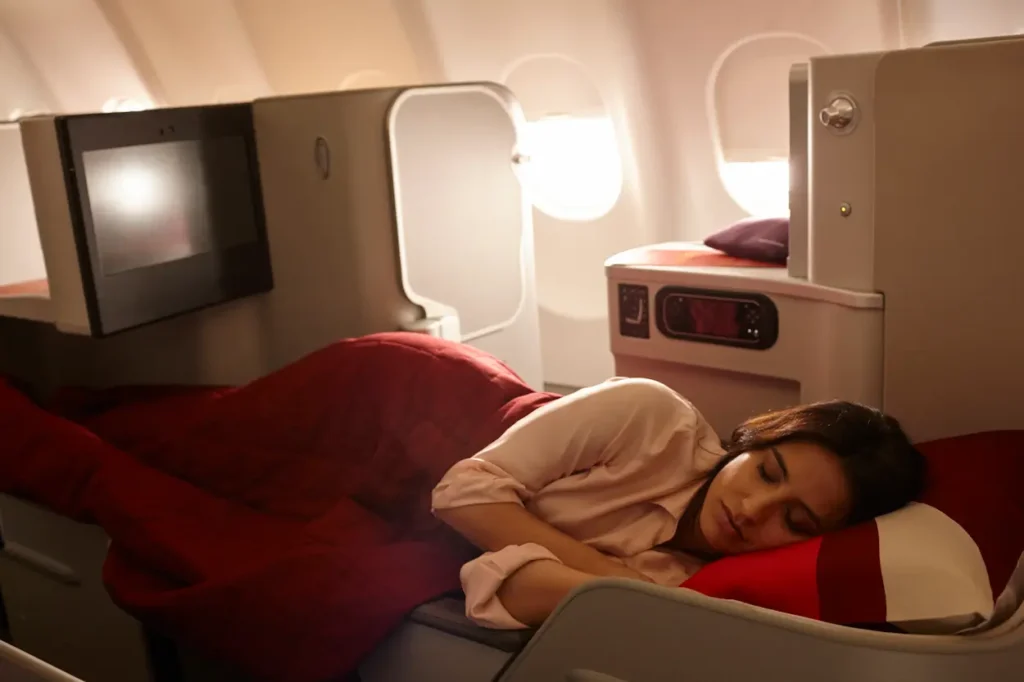
Here’s where I have to be honest – the bedding is fine but not amazing. You get a pillow, duvet, and a thin fabric mattress pad at your seat. The mattress pad helps, but it’s not the plush hotel-quality topper you’ll find on Air France or United. I know several frequent Iberia flyers who bring their own inflatable mattress pads for longer flights.
The pillow is decent and the duvet is warm. On overnight flights, the crew dims the lights quickly after dinner and generally leaves you alone, which I appreciate. The A350 is noticeably quieter than the A330 if you’re a light sleeper. One warning: if you’re over 6’3″, the footwell can feel cramped, especially on the A330.
Wi-Fi and entertainment
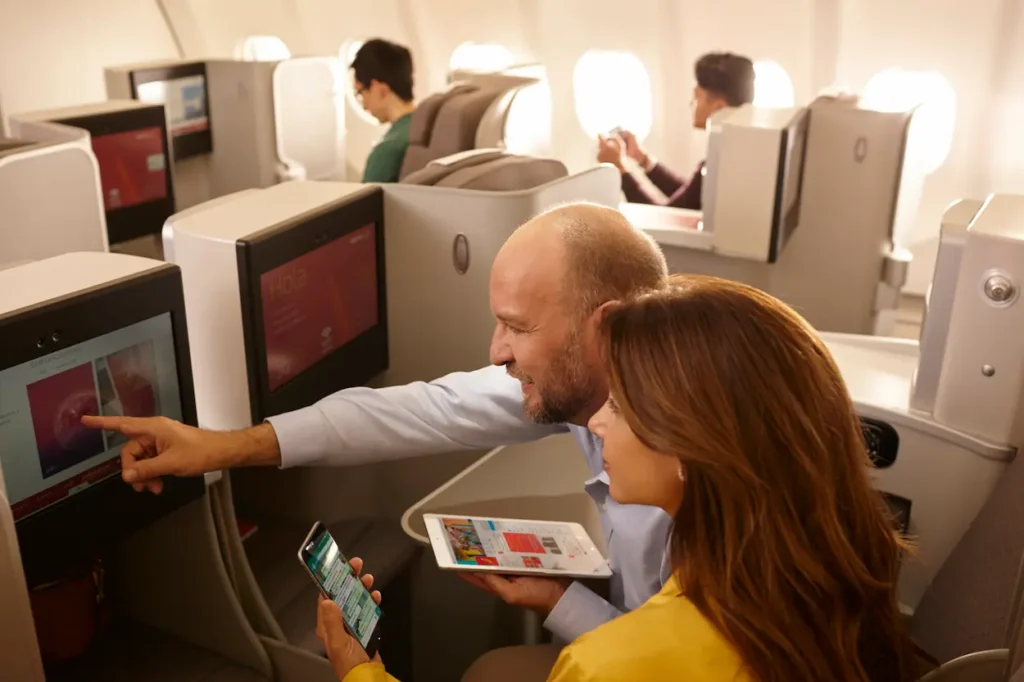
The entertainment varies by plane. A350s and A321XLRs have 18.5-inch 4K screens with Bluetooth, so you can use your own headphones. Picture quality is excellent and the interface is smooth. Movie and TV selection is great, with hundreds of options including Spanish content. The A330s have smaller 15.4-inch screens that aren’t as sharp but work fine.
Iberia offers in-flight Wi-Fi. Business class passengers and Iberia Plus members (free to join) get complimentary messaging on WhatsApp, Messenger, and similar apps. Full internet costs around €17-25 per flight. Speeds are okay for work emails and light browsing but can be patchy over the Atlantic.
Big news: Iberia’s rolling out free Starlink Wi-Fi across the fleet in 2026. I can’t wait to try it out.
Amenity kits and extras
The amenity kit is basic. It includes socks, eye mask, earplugs, dental kit, and hand cream from Spanish brand Uvas Frescas. I recommend bringing your own sleep mask if you care about the fit; theirs has tight elastic.
You get noise-canceling headphones, but they’re unbranded and mediocre. Use Bluetooth with your own headphones on newer planes. Hot towels before meals are a nice touch. Lavatories have soap but that’s about it for toiletries.
Storage depends on the aircraft. The A350 “Next” has a closed compartment and some open storage. The A321XLR has surprisingly good storage for a narrowbody, including space under the ottoman and oversized overhead bins. All seats have universal power outlets, USB-A, USB-C, and wireless charging on the newest planes.
Dining and drinks in Iberia Business Class
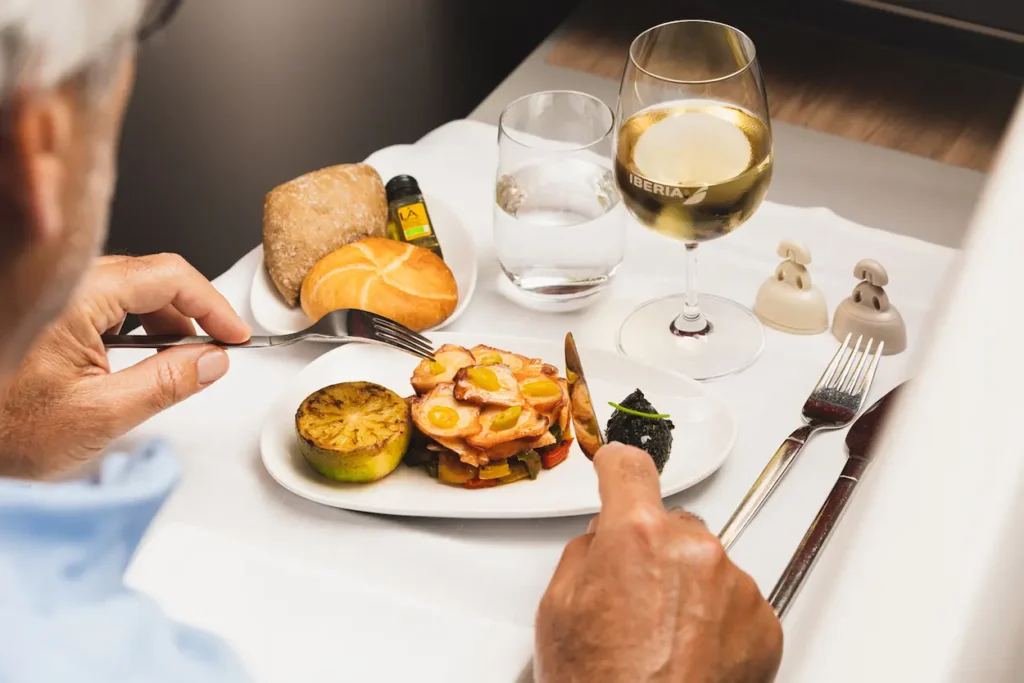
Iberia partners with DO&CO for catering, and the focus is Mediterranean cuisine with Spanish ingredients. On long haul flights, you get a full meal after takeoff with appetizers, mains, and dessert. The main service is usually good. I’ve had grilled beef tenderloin that was properly seasoned, baked hake (sometimes overcooked), and ricotta ravioli on recent flights. Appetizers are consistently good with options like smoked salmon, burrata, or grain salads.
The warm bread with olive oil is excellent, and the Spanish cheese plate is worth a try. Desserts are fine but nothing special. Pre-arrival meals are disappointingly small. You’ll get a sandwich or cold snack when you’re expecting a proper meal. It’s been a complaint for years and they haven’t fixed it. Catering quality depends entirely on where you depart from. Flights leaving Madrid have noticeably better food than outstation departures. If you’re leaving from Dallas or San Francisco, the quality drops.
The wine selection is where Iberia shines. They serve only Spanish wines and it’s impressive. Good Rioja reds, Albariño whites, and regional varietals you’d order at a restaurant. They also serve Mahou beer and Spanish cava instead of champagne. Some people complain about the cava, but I think it’s quality stuff and fits the airline’s identity.
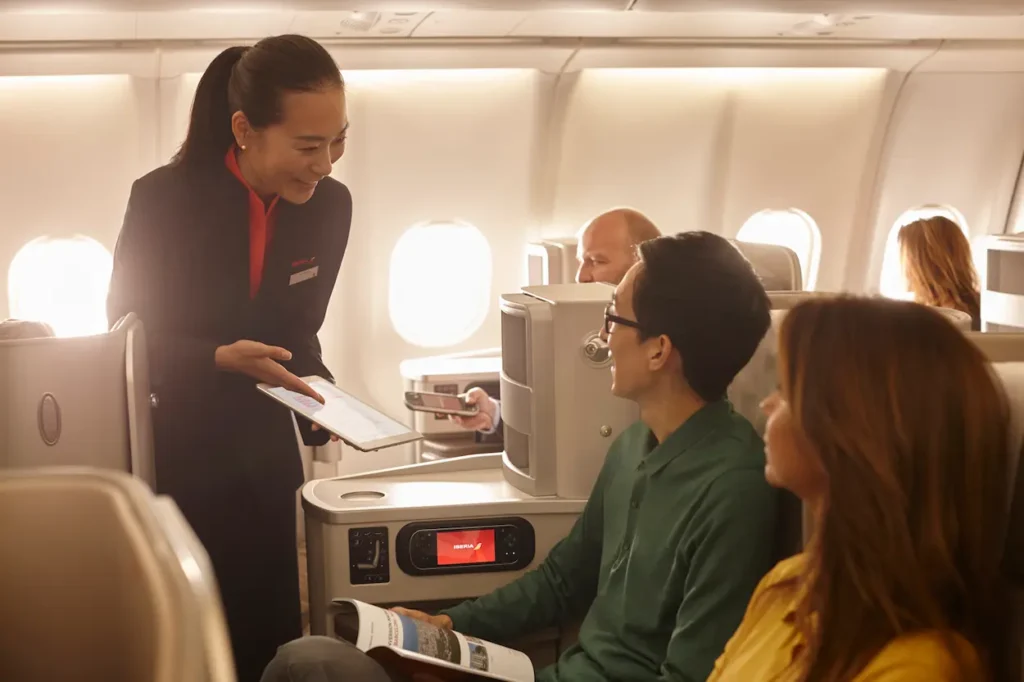
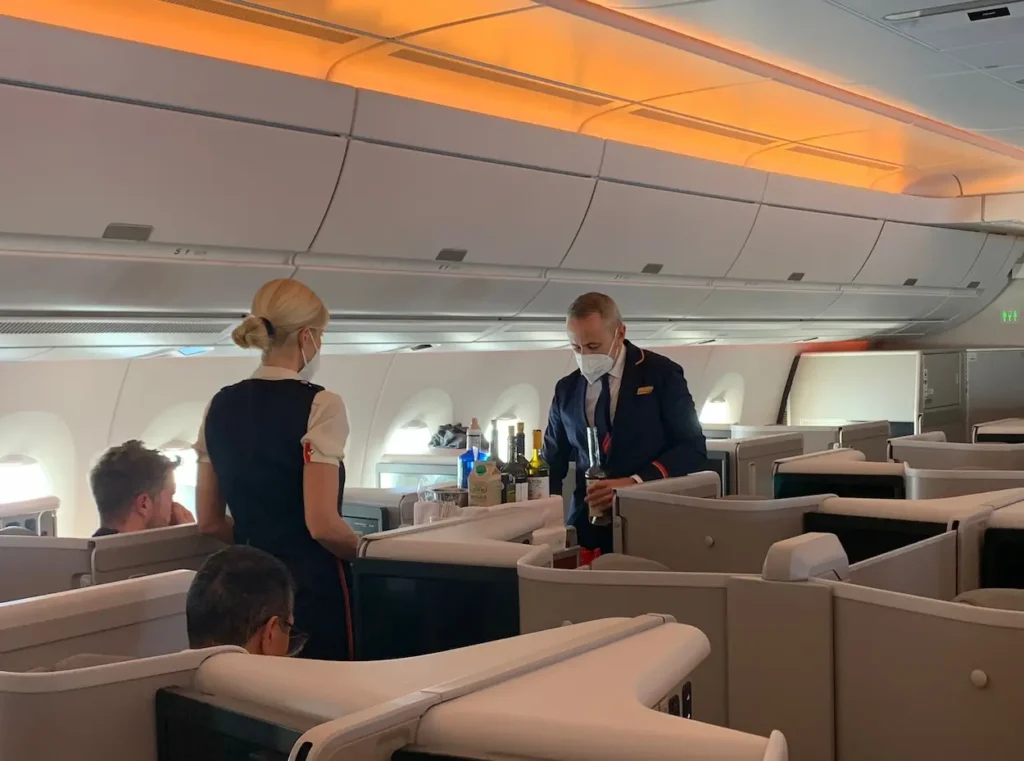
All alcohol is complimentary and crews pour generously. Coffee from the Lavazza machines is good. Between meals, there’s a Gastrobar service with snacks in the galley, though it’s not always well stocked. Service efficiency varies. On widebody flights it’s usually smooth. On the A321XLR, the tight galley means service feels more rushed.
Iberia Business Class vs. other airlines
When you’re choosing between transatlantic carriers, here’s how Iberia actually stacks up against the competition.
Iberia vs British Airways
BA’s Club Suite is excellent when you get it, with better privacy and a more polished feel than Iberia’s older cabins. But BA still operates a lot of flights with their ancient yin-yang seats, and the product is frustratingly inconsistent.
Iberia wins on food and wine. I’ve flown both multiple times, and Iberia’s Spanish wine selection and Mediterranean catering are noticeably better than BA’s safe (and somewhat boring) offerings. The Madrid lounges are also better than most BA lounges outside Heathrow. Service quality is similar on both, meaning hit or miss depending on your crew.
The big advantage with Iberia is pricing. Award seats cost the same in Avios. Despite this, I’ve found Iberia often has better availability and lower cash fares, especially to Latin America.
Iberia vs Air France
Air France business class has the superior hard product if you get their new A350 suites with Sofitel mattress pads. The bedding alone is in a different league. Their lounges in Paris are more refined, and the overall experience feels more premium when everything goes right.
But I’ve noticed Air France’s service can be indifferent, especially between meal services when crews disappear. Iberia’s Spanish hospitality is warmer and more personal. Food quality is roughly equal. Air France leans French, Iberia leans Mediterranean. Both are good.
The real difference is connecting airports. Paris CDG is a mess with long walks, confusing terminals, and brutal immigration lines. I’ve spent over an hour in line there multiple times. Madrid is more manageable. If you value a smoother connection, Iberia wins.
Iberia vs TAP Portugal
TAP is commonly known as the best airline to fly to Portugal, and often beats Iberia on price, which makes them tempting. Their newer A330neo business class seats are solid. But TAP’s service is wildly inconsistent. I’ve heard too many horror stories from readers about rude crews and chaotic operations, and the few times I’ve flown them, the experience was mediocre at best.
Iberia is more reliable. The hard product is better across the fleet with consistent 1-2-1 layouts. The food is better. The lounges in Madrid are significantly nicer than TAP’s single lounge in Lisbon. And Iberia’s network, especially to Latin America, gives you far more routing options. If TAP is dramatically cheaper and you’re going to Portugal specifically, fine. Otherwise, I’d book Iberia.
Overall, Iberia won’t blow you away like Qatar or Singapore, but it’s a solid, comfortable transatlantic product with genuinely good Spanish wine and food. If you can get the A350 “Next” with doors, it competes well with anything else crossing the Atlantic. The older planes are fine but not special. The real strength is value, especially when booking with Avios from the East Coast.
Iberia Business Class vs Premium Economy
Premium economy on Iberia gives you wider seats (19 inches vs 18 in economy), more legroom (37 inches vs 31), better recline, priority boarding, and two free checked bags instead of one. The cabin is intimate with just 21-24 seats in a 2-3-2 or 2-4-2 layout. You get a bigger entertainment screen and slightly better food presentation.
Premium economy doesn’t include lounge access, lie-flat seats, dedicated check-in counters in most airports, or meaningfully different meal service. The food is essentially the same as economy but on nicer plates. Service quality is identical. You still pay for spirits and snacks. Wi-Fi still costs extra unless you’re an Iberia Plus member.
Business class gives you a completely different experience. You get a flat bed, lounge access, priority everything, free premium alcohol, and actual differentiated meal service with Spanish wines. The gap between premium economy and business is massive.
Here’s where it gets interesting with Avios. On a flight from New York to Madrid, premium economy costs around 25,000 Avios one-way off-peak. Business class costs 34,000 Avios. That’s only 9,000 more Avios for a lie-flat bed, lounges, and proper meal service. The value gap is huge. I’d save the extra miles for business every time.
If you’re paying cash, premium economy is typically 50% more than economy, while business is 3x the premium economy price. In that case, premium economy makes more sense if you just need more legroom and business is way out of budget. But if you’re using miles, skip premium economy and go straight to business.
Frequently Asked Questions (FAQs) about Iberia business class
Are you still curious about which airline is the best to fly to Spain? Here are some questions I get asked a lot that will help decide whether Iberia business class is the right option for you.
Does Iberia business class have flat beds?
Yes, Iberia’s long-haul business class seats recline into fully flat beds. The seats are arranged to ensure direct aisle access for every passenger.
What is the difference between Iberia business class and premium economy?
The main differences between Iberia’s business class and premium economy include the level of comfort, service, and amenities. Business class features lie-flat beds, premium dining, and exclusive lounge access. In contrast, premium economy offers more space than economy with additional legroom and wider seats, enhanced meal service, and extra baggage allowance. It doesn’t include flat beds or lounge access.
Does Iberia business class get lounge access?
Yes, passengers flying in Iberia business class have access to Iberia’s business lounges and, through its membership in the Oneworld alliance, to over 650 lounges worldwide. These lounges provide a quiet space to relax or work, with food, drinks, showers, and more available.

Global Viewpoint is a personal blog. All content is for informational and entertainment purposes only and does not constitute professional financial, medical, or legal advice.