Mostar hits you different than other European cities. I remember driving in during my wider Balkans road trip, watching the landscape shift from the rugged Dinaric Alps to this valley where minarets and church spires share the same skyline. The moment you see the legendary Stari Most (Old Bridge) arching impossibly high over the turquoise Neretva River, you understand why this place is a UNESCO World Heritage treasure. It feels like a perfect, if fragile, blend of history, resilience, and raw beauty.
But Mostar is more than just that one famous photo op. I’ve explored the cobblestone alleys myself, and I learned quickly that this city rewards the prepared traveler. It’s a place where the history is complex, the coffee culture is a serious ritual. And trust me on this…the bridge stones are slippery enough to wipe you out if you aren’t wearing the right shoes.
In this guide, I’m sharing the real details from my road trip: from the new 2026 logistics you need to know, to the best spot for sunset drinks, and the 11 experiences that will make you fall in love with Bosnia and Herzegovina.
What’s New: Visiting Mostar in 2026
Mostar has changed quite a bit in the last few years. While the Old Bridge remains timeless, the logistics of visiting in 2026 are different. Here’s the latest scoop to help you plan:
- 🚗 The “Počitelj Bridge” Effect: The massive new bridge on the Corridor Vc highway is fully operational. This is a game-changer for road trippers coming from Croatia (Split or Dubrovnik). What used to be a slow, winding drive is now significantly faster, thanks to the Hercegovina Bridge (locally called the Počitelj Bridge), which opened in September 2024. Bonus: It makes a pitstop at the medieval walled town of Počitelj easier than ever. Don’t skip it!
- ✈️ Mostar Airport (OMO) is Waking Up: For years, flying here was nearly impossible. There’s now a real, if seasonal, route network: Air Serbia flies Belgrade year-round, Croatia Airlines connects to Zagreb, and seasonal routes bring in Sky Alps from a handful of Italian cities (Bari, Bergamo, Palermo, Rome) and Eurowings from Germany (Düsseldorf, Stuttgart). Check flights directly to Mostar before booking that bus from Sarajevo, you might save yourself a transit day.
- 💰 Prices are Creeping Up: Bosnia is still one of Europe’s best bargains, but it isn’t “dirt cheap” anymore. Restaurant and hotel prices nationwide were still climbing about 6.7% year-over-year as of February 2026, and Mostar is one of the pricier stops in the country. Since January 1, 2026, the city also charges a sojourn tax of about 3 KM (roughly €1.50) per person, per night, for overnight stays. Budget Tip: The currency is the Convertible Mark (KM), fixed at 1 EUR = 1.955830 KM. Euro cash is usually accepted, but your change tends to come back in KM at a weaker implied rate, so it’s worth paying in KM where you can. ATMs are common around the Old Bazaar; the small stalls right by the bridge tend to be cash-only.
- 🛑 The “Day Trip” Warning: In 2026, midday crowds (11:00 AM – 3:00 PM) are more intense than ever due to cruise ship excursions from Dubrovnik.
- The Hack: Do not just day-trip here. Stay the night. Tour coaches typically arrive around 10 to 11 AM and clear out by 5:30 to 6 PM, so that’s when Mostar transforms. You’ll have the Stari Most nearly to yourself, lit up at night, if you’re there before about 9:30 AM or after roughly 6:30 PM. Visiting in the shoulder months (May, June, September, October) gets you that same quiet with better weather than the July to August peak.
- 🍷 The Herzegovina Wine Boom: The region is finally getting international recognition for its wine, specifically the indigenous Žilavka (white) and Blatina (red). Several wineries near Mostar have upgraded their tasting rooms for 2026. If you see a “Vinska Cesta” (Wine Road) sign, follow it!
🔗 Helpful Resources for 2026 Planning:
- Official Train Schedules: zfbh.ba/en – Check the “Sarajevo to Mostar” timetable here.
- Herzegovina Wine Map: hwr.ba – The official map of all wineries on the new wine road.
- Mostar Pass: pass.mostar.ba – Launched in April 2025, it bundles the bridge diving demo, the Peace Bell Tower, Koski Mehmed Pasha Mosque, the Cathedral, and the Museum of Herzegovina for about 50 KM plus VAT (roughly €26 to €30). It’s sold online only and redeemed by QR code.
🚙 Getting to Mostar (and When to Actually Visit)
Most travelers arrive as a day trip from the Croatian coast or as a stop on a longer Balkans loop. Here’s how the main routes stack up:
| From | Distance / Drive | Border |
|---|---|---|
| Dubrovnik | ~131 km / ~2.5 hrs | 1 crossing (via the Pelješac Bridge) |
| Split | ~165 km / ~2.5 hrs | 1 inland crossing |
| Sarajevo | ~130 km / ~2 to 2.5 hrs | None (scenic M17 route) |
One planning note for 2026: the EU’s new Entry/Exit System, a biometric registration process for non-EU travelers, went live at Croatia’s borders by April 2026 and can add to wait times on your first crossing, so build in some buffer if you’re driving in from Dubrovnik or Split.
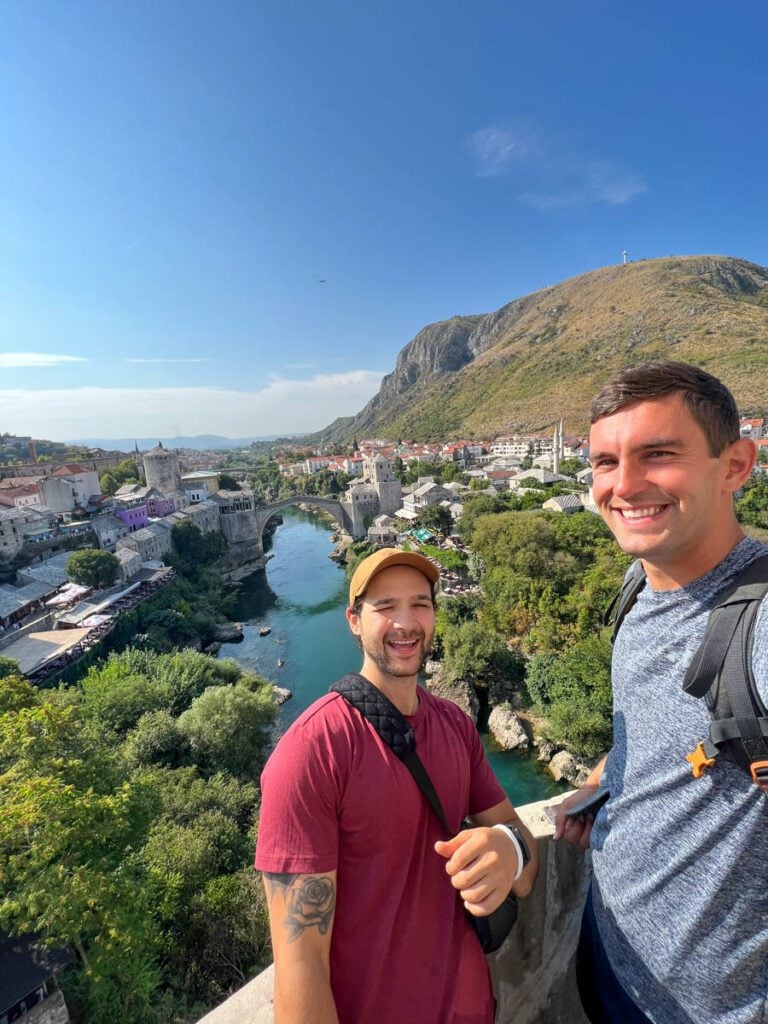
Best Things to See and Do in Mostar, Bosnia and Herzegovina
Looking for the coolest things to do in Mostar, Bosnia and Herzegovina? Walk across the iconic Stari Most, visit the historic Koski Mehmed Pasha Mosque for stunning panoramic views, and explore the beautiful Blagaj Tekija, a mystical monastery by the river. Sip refreshing drinks at Ali Baba Cocktail Bar, step back in time at Muslibegović House, and soak in the city’s unique blend of Ottoman and Mediterranean influences.
Mostar’s attractions are spread between the Old Town and nearby Blagaj, so I mapped out all my favorite spots below. Save this map to your phone so you can easily navigate between the iconic Stari Most and the stunning Buna River Spring!
1. Stari Most
Walking across Stari Most, Mostar’s iconic Ottoman bridge, was a memorable part of my visit to Bosnia and Herzegovina. Standing midway, I paused to watch daring locals dive nearly 70 feet (about 21 meters) into the clear Neretva River, a sight that definitely gets your heart racing! Destroyed during the Bosnian War and rebuilt in 2004, this UNESCO landmark symbolizes unity and resilience.
The bridge’s story is worth knowing before you cross it. The Ottomans completed the original Stari Most in 1566, commissioned by Suleiman the Magnificent and traditionally credited to the architect Mimar Hayruddin (a “student of Sinan,” as the story is usually told, though that lineage isn’t firmly settled). Bosnian Croat HVO forces destroyed the bridge with tank shelling on 9 November 1993, during the Croat-Bosniak phase of the Bosnian War. It reopened on 23 July 2004, and UNESCO inscribed the Old Bridge Area of the Old City of Mostar as a World Heritage Site in 2005. Look closely at the stone and you’ll notice it isn’t uniform: only around 30% of today’s bridge is original material recovered from the riverbed. The rest is newly quarried Tenelija limestone.
The bridge itself is free to cross and open around the clock. If you want the full story behind it, the Old Bridge Museum inside Tara Tower charges around 10 KM (about €5) and is open daily from 10:00 AM to 6:00 PM, April 1 through November 1. The divers gathered on the parapet belong to the Mostari diving club (“Ikari” is a nickname you’ll see used generically for Mostar’s bridge divers, not the actual club name); they usually collect a small fee from spectators, somewhere around €2 to €5, before they jump. The actual leap is roughly 21 to 24 meters, with 24 meters as the standard jump (not the 27 to 28 meter platform sometimes mentioned online, that’s a temporary rig used for the Red Bull cliff diving competition, not the everyday jump). If you’d rather participate than watch, the club runs tourist training sessions that end in a supervised jump for around €25, though prices run as high as €50, and an actual jump off the bridge itself isn’t guaranteed.
⚠️ Pro Tip for Crossing: The bridge is surprisingly steep and the limestone is slippery as ice (even when dry). Look for the raised stone ribs (tenelija) running horizontally across the bridge, and use them like ladder rungs to grip your feet as you walk up and down.
Afterward, I relaxed at Café de Alma, tucked behind the Old Bridge on the west bank, savoring authentic Bosnian coffee roasted fresh onsite (a cup runs around 5 KM, about €2.50, and they’ll walk you through the whole ritual). For something sweet, locals recommended Palma Cafe, known for delicious desserts like palacinke (Bosnian crepes).

2. Blagaj Tekija
Nestled at the base of a towering cliff in Blagaj, the Blagaj Tekija is a 16th-century Dervish monastery that offers a serene glimpse into Sufi traditions. Adjacent to the monastery, the Vrelo Bune emerges from a cavern. This isn’t just a stream; it is one of Europe’s strongest karst springs, pushing out as much as 43,000 liters of water per second at peak flow.
The water comes from deep underground aquifers, which is why it stays cold, generally around 8 to 10°C, year-round. While the tranquil ambiance and flowing water create a peaceful retreat, the geological wonder right next to the monastery is equally powerful. Visiting the tekija itself costs around 10 KM (about €5), payable in cash, and there’s a dress code: shoulders and knees covered, and women should cover their hair (scarves are provided if you don’t have one) and remove their shoes before going inside. It’s generally open from around 8:00 AM to 8:00 PM, April through October.
✈️ My #1 Tip for Cheap 2026 Flights:
It’s summer, so flight prices are climbing fast - but you don't have to pay them. I’m currently seeing roundtrips to Europe for under $350 (deals you won’t find on Google Flights).
Step 1: Join Going.com's Free Plan here . It takes 10 seconds and requires no credit card.
Step 2: If you're doing a big trip this year, grab the 14-day free trial of Premium. You can even use my code JON25 for 25% off.
Seriously, this is the single best money-saving tool I’ve used in 10+ years.
👉 Send me cheap 2026 flightsDuring my visit, I enjoyed a meal at the riverside restaurant, savoring traditional Bosnian dishes (like fresh trout) while taking in the picturesque surroundings. A short hike up the hill led me to the Blagaj Fortress, also known as Stjepan-grad, offering panoramic views of the valley below.
- Blagaj Tekija offers serene riverside views and history on this Blagaj Tekija & Buna River tour.

3. Koski Mehmed Pasha Mosque
Located in the heart of Mostar’s Old Town, the Koski Mehmed Pasha Mosque stands as a testament to Ottoman architecture from the early 17th century. Its distinctive minaret and vibrant interior decorations provide insight into the region’s rich cultural heritage. Climbing the narrow staircase of the minaret rewards visitors with a stunning panoramic view of the iconic Stari Most (Old Bridge) and the Neretva River flowing beneath. Expect a small entry fee, reported anywhere from about 12 to 15 KM (roughly €5 to €8) depending on the season, so it’s worth confirming the price on-site. The mosque is generally open from around 8:30 AM to 7:00 PM.
After exploring the mosque, I wandered through the nearby Kujundžiluk Bazaar, where artisans sell traditional crafts, jewelry, and textiles, reflecting the area’s artisanal traditions. Stopping by the historic Muslibegovic House, now a museum and hotel, offered a deeper understanding of Ottoman-era residential architecture. The combination of spiritual, cultural, and historical experiences around the Koski Mehmed Pasha Mosque provides a comprehensive glimpse into Mostar’s enduring legacy.

4. Ali Baba Cocktail Bar
Relaxing at Ali Baba Cocktail Bar after a day exploring Mostar quickly became a personal favorite of mine. What makes it special is that it’s built right into a 15th-century cave (locals call it “Pećina”) tunneled into the cliff above the Neretva River, with the terrace opening onto views of the iconic Stari Most. Colorful lanterns and vibrant cushions fill the cave-carved space, giving it an inviting, hidden-gem atmosphere, and there’s no entry fee.
Ali Baba offers a wide variety of cocktails, from classic recipes to creative house specialties. My suggestion is to arrive early to snag a seat with a clear view, especially at sunset when the scenery is spectacular. One thing worth knowing: the cave-level section sometimes runs on a seasonal or weekend-only (Friday and Saturday) schedule, so it’s worth confirming hours locally rather than counting on it being open every night. The music is lively yet not overwhelming, making it easy to chat or simply take in the surroundings. Whether you’re craving a unique drink or unforgettable views, Ali Baba Cocktail Bar is a great way to end your day.
5. Muslibegović House
Exploring Muslibegović House, an impressive Ottoman-era residence, gave me a glimpse into Mostar’s fascinating past. Built in the 18th century, this beautifully preserved house is now a boutique hotel and museum, showcasing traditional rooms, antique furnishings, and intricate wood carvings. Walking through its serene courtyard, I felt transported back to an elegant era.
Don’t miss the carefully preserved bedrooms, where detailed textiles and ornate ceilings reflect rich Ottoman craftsmanship. The museum section includes historic artifacts and exhibits illustrating Mostar’s heritage. When visiting, be ready to remove your shoes before entering certain rooms, as is local custom. A walk-in museum visit costs around 5 to 6 KM (about €2.50 to €3), and it’s generally open to visitors from about 10:00 AM to 6:00 PM. Located close to the Old Town area, Muslibegović House perfectly combines luxury and history, providing a unique glimpse into Bosnian culture. It’s a great spot for travelers wanting to experience Mostar’s authentic past in a beautiful, relaxing setting.

6. Old Bazaar Kujundžiluk
Exploring the Old Bazaar Kujundžiluk felt like stepping into a vibrant piece of Mostar’s past. This bustling bazaar street, dating back to Ottoman times, is lined with charming stone shops selling traditional Bosnian crafts, from intricate copperware and colorful scarves to handcrafted jewelry. As I wandered through, the aroma of freshly brewed Bosnian coffee filled the air.
Walking through the bazaar itself doesn’t cost anything, you’re only paying for what you buy. I enjoyed stopping by Coppersmith Street, where local craftsmen demonstrated traditional copper-smithing techniques right before my eyes. Don’t be shy about haggling, it’s part of the experience and can earn you a great deal. Nearby, Palma Cafe offers delicious desserts like palacinke (Bosnian crepes). Wear comfortable shoes, as cobblestone streets here can be uneven. Visiting Kujundžiluk Bazaar immerses you in Mostar’s lively culture, making it a perfect place to shop, eat, and soak up local life.

7. Buna River Spring
Visiting Buna River Spring near the village of Blagaj was one of my favorite day trips from Mostar. Known locally as Vrelo Bune, this natural spring emerges dramatically from a cave beneath a towering limestone cliff. The crystal-clear, emerald-colored water flows into the Buna River, creating an incredibly scenic landscape that feels refreshingly peaceful, even during peak tourist season.
During my visit, I rented a wooden boat to explore the spring up close, definitely an activity worth trying. Nearby, you can also stop at the historic Blagaj Tekija, a centuries-old Dervish monastery blending seamlessly into the cliffside. Along the riverbanks, cozy restaurants serve freshly grilled trout, letting you enjoy a relaxing lunch with unmatched views. Whether you’re into nature, history, or delicious Bosnian cuisine, Buna River Spring makes for a perfect escape from the city. Getting to the spring itself is free, aside from a small parking fee of around €1.
If you have your own transport, a lot of visitors pair Blagaj with Kravice Falls, Herzegovina’s other big natural draw, about 40 km away (roughly 45 to 55 minutes’ drive). Admission runs €10 (20 KM) per adult from April through October and is free the rest of the year. Without a car, a guided day tour from Mostar bundles Blagaj, Počitelj, and Kravice Falls into one trip.

8. Mepaš Mall
For a change of pace from Mostar’s historic sights, head to Mepaš Mall, the city’s modern shopping hub. It’s not within walking distance of the Old Town, so plan on a short taxi or bus ride, but once there this contemporary mall offers international brands, boutique shops, and entertainment options, making it popular with locals and visitors alike. Entry is free, and it’s open from about 9:00 AM to 9:00 PM Monday through Saturday (closed Sundays). You can easily spend a few hours browsing stores like Zara, New Yorker, or dm drogerie markt.
During my trip, I stopped by the CineStar cinema located inside the mall to catch a film after shopping. There’s also a lively food court where you can try Bosnian specialties or grab a quick coffee break. If you’re traveling with kids, the mall has plenty of family-friendly attractions, including an arcade. Whether shopping, dining, or simply escaping the summer heat, Mepaš Mall is a convenient, air-conditioned spot that complements Mostar’s traditional attractions.

9. Biscevic House
Step into the past by visiting Biscevic House, an authentic 17th-century Ottoman residence located right along the Neretva River. The house perfectly preserves traditional Bosnian architecture with ornate wooden interiors, beautiful carpets, and intricately carved furniture. It gives a rare glimpse into the lavish lifestyle once enjoyed by Mostar’s elite families during Ottoman rule. Entry costs around 4 to 6 KM (about €2 to €3).
I particularly enjoyed relaxing in the breezy divan room, known as the “conversation room,” which overlooks the river and gardens below. Hiring a local guide here is helpful since they’ll explain fascinating details you might otherwise miss, like hidden meanings behind the décor. Remember to wear easy-to-remove shoes, as guests traditionally take them off before entering. Visiting Biscevic House isn’t just sightseeing, it’s an intimate exploration of Mostar’s cultural heritage and a relaxing break from the bustling streets outside.

10. Mostar Peace Bell Tower
Climbing the Mostar Peace Bell Tower gives you incredible views of the entire city and surrounding hills. Standing about 107 meters tall, the tower was built next to the Church of St. Peter and St. Paul, symbolizing peace and reconciliation after the war. Admission runs about 6 KM (roughly €3) for adults and 2 KM (about €1) for children, and it is generally open from 9:00 AM to 7:00 PM on weekdays and 1:00 PM to 5:00 PM on Sundays (worth calling ahead to check Saturday hours). From the top observation deck, you’ll spot landmarks like Stari Most, the Neretva River, and the city’s picturesque rooftops stretching toward the mountains.
When I climbed the tower, I timed it perfectly for sunset, a moment I’ll never forget. The panoramic scenery and golden-hour lighting made it ideal for capturing memorable photos. One thing to know before you go: the climb is not fully step-free. An elevator covers roughly the first 45 meters, but from there you are on foot, somewhere between 100 and 150 stairs, to reach the 75-meter viewing platform, so it is not the easiest climb if you have mobility concerns. If you’re seeking both spectacular views and deeper insight into Mostar’s story of resilience, adding the Peace Bell Tower to your itinerary is an excellent choice.

11. Karadjoz Bey Mosque
One of the city’s most remarkable historic landmarks is the Karadjoz Bey Mosque, a beautiful 16th-century Ottoman mosque in Mostar’s Old Town. Commissioned by Mehmed Bey Karadjoz, the mosque showcases elegant Islamic architecture, with a striking domed roof, an ornate minaret, and intricate decorations inside. Stepping through its gates feels like entering a serene sanctuary amid the city’s busy streets.
During my visit, climbing the minaret rewarded me with unforgettable views of Stari Most and Mostar’s charming rooftops. The courtyard is equally inviting, shaded by leafy trees perfect for taking a short rest. Visitors should dress modestly, with women covering their hair out of respect. There is a small entry fee, somewhere in the 6 to 8 KM range (roughly €3 to €4), though it is worth confirming locally since posted rates can vary, and like most active mosques in the city, it is open to visitors outside of prayer times. Whether you’re interested in history, architecture, or simply a peaceful spot to unwind, the Karadjoz Bey Mosque is an enriching stop, reflecting Mostar’s diverse heritage.

My Bonus Content: How to Drink Bosnian Coffee
You cannot leave Mostar without trying Bosnian Coffee. It looks like Turkish coffee, but the preparation and serving style are distinct. It is usually served on a copper tray (tabla) with a džezva (pot), a fildžan (cup), a glass of water, and a sugar cube (rahat lokum).
How to drink it like a local:
- Don’t drink it immediately! First, spoon out a layer of foam into your empty cup.
- Pour the coffee slowly from the pot to preserve the grounds at the bottom.
- Do not put the sugar in the coffee. Instead, take a small bite of the sugar cube, keep it in your cheek, and sip the coffee through it. This balances the bitterness perfectly.
Here’s my Instagram video showing my favorite coffee spot in Mostar with a view!


Global Viewpoint is a personal blog. All content is for informational and entertainment purposes only and does not constitute professional financial, medical, or legal advice.