Switzerland in December feels like stepping into a snow globe, and I’ve been lucky enough to experience it many times while traveling through Europe. Over the years, I’ve explored Christmas markets across a dozen countries, and the Swiss ones always stand out. From Zurich’s glittering streets to Basel’s medieval charm, each market offers plenty of mulled wine, history, culture, and pure winter magic to life. As a travel blogger (and someone who spends a couple months in Europe each year thanks to my Austrian wife), I’ve narrowed down the markets that truly deliver. Here are 15 Swiss Christmas markets in 2026 that deserve a spot on your holiday bucket list.
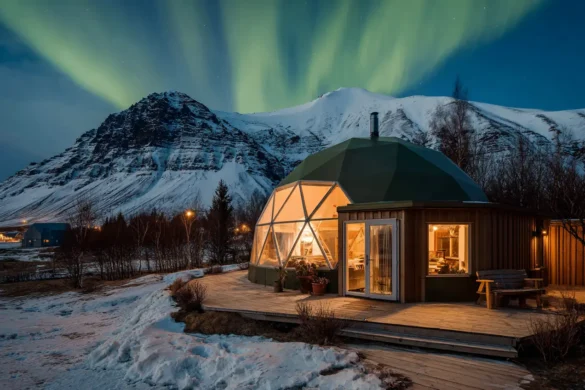
- 👉 Pro Tip: For a magical Christmas experience in the heart of the Swiss Alps, I HIGHLY staying at this resort with views of the Matterhorn. Located in Zermatt, the OMNIA is incredibly beautiful and luxurious, and it’s super close to Zermatt’s nicest ski slopes and iconic peaks. In my opinion, it’s an absolute must-do on a Switzerland winter itinerary in my opinion.
How to Plan a Swiss Christmas Market Road Trip
Switzerland’s markets are spread across the country, but the rail network makes hopping between them simple. The Swiss Travel Pass covers unlimited rides on SBB trains, PostBuses, lake boats, and city trams in 90+ towns, plus free entry to 500+ museums and 25-50% off mountain railways. 2026 pricing starts at CHF 254 for 3 days (2nd class) and goes up to CHF 499 for 15 days. The Flex version costs about 15% more for non-consecutive travel days, travelers aged 16-25 get roughly 30% off with the Youth Pass, and kids under 16 ride free with the Swiss Family Card.
A few itinerary loops I’d recommend:
- 3-Day Market Sampler (Zurich Base): Zurich → Winterthur → Lucerne → Bern. All reachable in under 90 minutes from each other, and you can hit one or two markets per day.
- 5-Day Lake & Alps Loop: Geneva → Lausanne → Montreux → Bern → Basel. This follows the Lake Geneva shoreline before cutting north through the capital to Switzerland’s biggest market.
- 7-Day Grand Tour: Zurich → Basel → Bern → Montreux → Lausanne → Lugano (via Gotthard) → St. Gallen → back to Zurich. Heavy travel days, but you’ll cover all four language regions.
Practical tips: almost every market is within a 10-minute walk of the main train station (Bahnhof), and you can store luggage at the station and explore for a couple of hours between trains. Weekends and the days before Christmas Eve get crowded, especially in Basel, Zurich, and Montreux, so visit those midweek if you can. Book any panoramic train segments (Glacier Express, Bernina Express) well in advance because seat reservations are mandatory and sell out months ahead.
My Top 5 Swiss Christmas Markets At a Glance
I’ve visited Christmas markets across a dozen European countries over the years, and Switzerland never disappoints. These 15 Swiss markets are the ones I recommend to everyone planning a winter trip here. If you want a shortlist, these are my five favorites.
- Basel: The biggest market in Switzerland with 150 stalls across three old town squares, Feuerzangenbowle from Liechti’s legendary stall, and Basler Läckerli you’ll be craving for months.
- Montreux: 170 chalets along a kilometer of Lake Geneva shoreline, Santa flying overhead three times a night, and a medieval festival at Château de Chillon on Advent weekends.
- Bern: Three walkable markets in a UNESCO-listed old town, the Sternenmarkt overlooking the Parliament Building until 10pm, and the best fondue chalet seating in the country.
- Lucerne: Rudolf’s Christmas by the lake with fire pits and a fondue chalet, Öpfelchüchli from the old town stalls, and the Chapel Bridge lit up at night.
- Bremgarten: Over 250 stalls packed into a tiny medieval old town for four days in early December, 100,000 visitors, and one of Switzerland’s best-kept Christmas market secrets.

Lucerne
I’ve been to a lot of Christmas markets across Europe, and Lucerne keeps pulling me back. It’s smaller than Basel or Zurich, and I think that’s why it works. The old town market at Franziskanerplatz (December 3 to 21, 2026) has about 70 stalls tucked around the Franciscan Church. At night, when the lights come on and the choir starts singing, it feels like a completely different city. The second market to visit is Rudolf’s Christmas in Inseli Park (November 20 to December 23, 2026), which sits right on Lake Lucerne with fire pits and a fondue chalet that seats 140.
The food here punches above its weight. My go-to order is raclette from one of the lakeside stalls, followed by Öpfelchüchli (fried apple slices with cinnamon sugar) for dessert. If you only eat one thing, make it those. The fondue chalet at Rudolf’s is popular and seats fill up, so book online before you go. For drinks, the white wine Glühwein is worth seeking out over the standard red version.
Lucerne is also one of the easiest Swiss cities to explore on foot. The walk along the lake at night, past the Chapel Bridge with Christmas lights bouncing off the water, is one of the prettiest scenes I’ve encountered in December anywhere. If you have a spare morning, the cogwheel railway up Mount Pilatus gives you panoramic views across the Alps. I’d plan a weekday visit if you can. Weekends get packed.

Basel
Basel’s Christmas market is the biggest in Switzerland. There’s around 150 stalls spread across three old town squares from November 26 to December 23, 2026. It won “Best Christmas Market in Europe” in 2021, and I think it deserves the title.
Barfüsserplatz is the main hub, busy and buzzing, with food and gift vendors packed around the Barfüsserkirche. I prefer Münsterplatz in front of the cathedral. It’s quieter, more atmospheric, and has a huge Christmas tree decorated each year by Johann Wanner. Cross the Mittlere Brücke into Kleinbasel and you’ll find the Adväntsgass along Rheingasse, a neighborhood food market where the locals go.
The thing I come back to Basel for is the food. Basler Läckerli are the city’s spiced honey biscuits made with almonds, candied peel, and Kirsch, and they’re addictive. Grab a tin from Läckerli Huus on Gerbergasse or eat them warm at the stalls. For drinks, find Hans-Rudolf Liechti’s stall on Barfüsserplatz and order the Feuerzangenbowle, a flaming punch where a rum-soaked sugarloaf is set alight and drips into red wine. You’ll smell it before you see it!
Between December 2 and 20, climb St. Martin’s Tower for CHF 5 to see the illuminated old town from above. Basel is also a short train ride from Strasbourg and Colmar, which makes it easy to combine Swiss and French Christmas markets in a single trip. Give this one a full day.
- Read next: Must-See Rhine River Destinations

Lausanne
In my opinion, Lausanne feels different from every other Swiss Christmas market. The city’s festival, Bô Noël, runs from mid-November through December 31 (exact 2026 dates to be confirmed on the official site) and spreads across six themed locations rather than one central square. It’s contemporary, design-forward, and younger in energy than Basel or Zurich. A free Christmas train shuttle connects the different areas.
Head to the Flon district first for the covered food market, Ferris wheel, and ice skating rink. For a sit-down meal, the Igloo du Terroir at Place de l’Europe serves regional fondues paired with Chasselas wines from the Vaud vineyards, and it’s one of the better places to eat at any Swiss market. The cinnamon crepes from the waterfront stalls are my go-to for something quick between stops.
The other reason to visit Lausanne in December is the Lausanne Lumières trail, a series of contemporary light installations scattered across the city’s landmarks including the Cathedral. It runs alongside the markets and gives the evenings a completely different atmosphere. If you’re already visiting Montreux, Lausanne is a short train ride along Lake Geneva and easy to combine in the same trip.
✈️ My #1 Tip for Cheap 2026 Flights:
It’s summer, so flight prices are climbing fast - but you don't have to pay them. I’m currently seeing roundtrips to Europe for under $350 (deals you won’t find on Google Flights).
Step 1: Join Going.com's Free Plan here . It takes 10 seconds and requires no credit card.
Step 2: If you're doing a big trip this year, grab the 14-day free trial of Premium. You can even use my code JON25 for 25% off.
Seriously, this is the single best money-saving tool I’ve used in 10+ years.
👉 Send me cheap 2026 flights
Bern
Bern’s old town is UNESCO-listed and looks like it was built for December. There are three main Christmas markets in Bern, and they’re all walkable from each other. Waisenhausplatz (November 27 to December 24, 2026) is the traditional one with 50-plus wooden chalets selling gifts and ornaments. Münsterplatz (November 28 to December 24, 2026) sits in front of the Bern Minster and focuses on handmade crafts sold by the artisans themselves. It’s smaller and quieter, and the mulled wine at the Märitbeizli is rumored to be the best in the city. I’d start there.
The Berner Sternenmarkt at Kleine Schanze park (November 19 to December 27, 2026) is the newest of the three and the one with the best atmosphere at night. It overlooks the Bundeshaus (Parliament Building), has 80 chalets, and stays open until 10pm on weeknights. The fondue chalet here seats 200 and is open late. One thing to know: the Sternenmarkt is fully cashless, cards or Twint only.
I’d recommend Bern for couples or anyone who wants a relaxed market visit without the crowds of Basel or Zurich. The arcaded medieval streets are perfect for walking between markets, and the whole old town is lit up through Advent. If your timing lines up, try to catch the Zibelemärit (onion market) in late November. It’s a one-day event where farmers sell 50 tonnes of braided onions, and the Zibelekuche (onion tart) sells out before lunch.
- Read next: Top Attractions in Bernese Oberland

Zurich
Zurich opens its Christmas markets around November 19, 2026, and all four sit within easy walking distance. Try to be on Bahnhofstrasse for 6pm on opening night, when the Lucy lights go on for the first time. Thousands of LED crystals cover the full length of the street, and locals come out in force to watch. It’s become a citywide event that kicks off the whole season.
The market I’d point you toward first is the Singing Christmas Tree at Werdmühleplatz. Here, local choirs perform on a tree-shaped stage every evening. There’s a fondue chalet right beside it, and sitting there eating cheese while the singing carries over is a great way to spend an hour. The Wienachtsdorf at Sechseläutenplatz by the opera house is the biggest market in Zurich, with 100-plus stalls and the widest food selection in the city. For gift shopping, head to Münsterhof by the Fraumünster, where the stalls stock local Zurich artisans.
Prices at Zurich’s markets are high even by Swiss standards, and the Wienachtsdorf draws big weekend crowds that make browsing difficult. A midweek visit is a much better experience if your schedule allows it. I’d also keep an eye out for the Illuminarium at the Landesmuseum courtyard (5th November to 30th December 2026), which does light projections, DJs, and food stalls in a completely different setting from the traditional markets.

Montreux
Montreux might have the best setting of any Christmas market in Switzerland. Over 170 chalets line a full kilometer of Lake Geneva’s shoreline from November 20 to December 24, 2026, with snow-capped mountains behind them and palm trees mixed in with the Christmas lights. Santa flies over the market in his sleigh three times every evening at 5pm, 6pm, and 7pm (plus 4pm on Saturdays). It sounds ridiculous until you see kids’ faces watching it happen!
For food, head to the Village des Bûcherons area where the larger restaurant chalets are clustered. Fondue and vin chaud are the staples, and the food stalls stay open later than the shopping chalets (until 11pm on Fridays and Saturdays). I’d also recommend a day trip to Château de Chillon on an Advent weekend (November 28-29, December 5-6, or December 12-13 in 2026), where they run a medieval festival with period cooking, blacksmithing, and craft demonstrations inside the castle walls. Admission is CHF 19 for adults.
If you’re traveling with kids, the cogwheel train up to Rochers-de-Naye takes you 2,000 meters up to Santa’s mountain grotto. It books out on weekends, so reserve ahead. The Freddie Mercury statue is right on the lakeside promenade in the middle of the market, and the free Queen Studio Experience inside the Casino Barrière is a fun detour between browsing stalls. Montreux is the Swiss market I’d recommend for families or for anyone who wants their Christmas market trip to feel like an event rather than just a browse.

Lugano
Lugano is the Swiss Christmas market to visit if you want something completely different. It’s in the Italian-speaking Ticino region, the food leans Mediterranean, and the weather is noticeably milder than the German-speaking cities. The market (called Natale in Piazza) runs from November 27, 2026 through January 6, 2027, which is a huge advantage if you’re traveling after Christmas.
Around 60 stalls spread between Piazza della Riforma, Via Nassa, and Piazza Manzoni. The food chalets between Riforma and Manzoni have DJ sets and light projections on the building facades in the evenings. Definitely order the Luganighe sausages, which are a regional pork specialty with garlic and red wine, and the polenta dishes and Ticinese risotto are far better than the standard market fare you’ll find up north. There’s also a submerged nativity scene that lights up in Lake Lugano after dark, which is unlike anything at the other Swiss markets.
Parco Ciani has a free ice skating rink and an ice minigolf course, and the funicular up Monte Brè gives you panoramic lake views on a clear day. If you can time it, the New Year’s Eve party in Piazza della Riforma draws a big crowd and is a great way to ring in 2027. I’d pair Lugano with a longer Italian Lakes trip, since Lake Como is about 40 minutes south by car.

St. Gallen
St. Gallen is called Sternenstadt (City of Stars) every December because 700 handcrafted stars get hung above the old town streets. The Christmas market opens November 26 and closes December 24, 2026, with about 50 wooden chalets spread from the Waaghaus along the Bohl to the Market Square. The Abbey of St. Gallen sits right behind it all, and the 20-meter Christmas tree on Klosterplatz is covered in thousands of lights. You can see everything here in a couple of relaxed hours.
I’d come to St. Gallen for the food alone. The St. Galler Bratwurst is famous across Switzerland, grilled fresh at the stalls and served with bread and mustard. Don’t add ketchup…locals will look at you sideways! The St. Galler Biber is the other thing to eat here, an almond-paste-filled gingerbread biscuit that’s been baked in this region for centuries. Food stalls stay open until 9pm on weeknights and 10pm on Thursdays, which gives you plenty of evening time.
While you’re here, walk into the abbey complex and visit the baroque library. It has an ornate painted ceiling and manuscripts dating back over a thousand years, and it takes about 20 minutes. If your timing lines up, the Chlausritt parade brings Father Christmas through the city on horseback. St. Gallen is about an hour from Zurich by train, and it’s a straightforward day trip.

Winterthur
Winterthur is 27 minutes from Zurich by train and has a Christmas market that deserves attention on its own. Now in its 29th year, it opens November 26 and goes through December 23, 2026, daily from 11am until late evening. Over 70 stalls sit on Teuchelweiherplatz under a canopy of lights, with a fondue chalet, heated lounges, and a Slalom Bar that brings an après-ski energy to the center of town. There’s also a separate old town market at Neumarkt with 60-plus stalls between the historic facades.
The design and product market is where I’d focus if you’re gift shopping. The vendors lean toward independent makers rather than the mass-produced items you find at bigger markets. The food offering is broader than you’d expect too, with international stalls alongside the usual raclette and Glühwein. It has a loyal local following and the crowd here is noticeably different from Zurich’s tourist-heavy markets.
I’d recommend Winterthur as a half-day trip from Zurich if you’ve already done the city markets and want something with a different feel. The old town is walkable and the two Christmas market areas are close together. You can comfortably see everything in a couple of hours without rushing.
Bremgarten
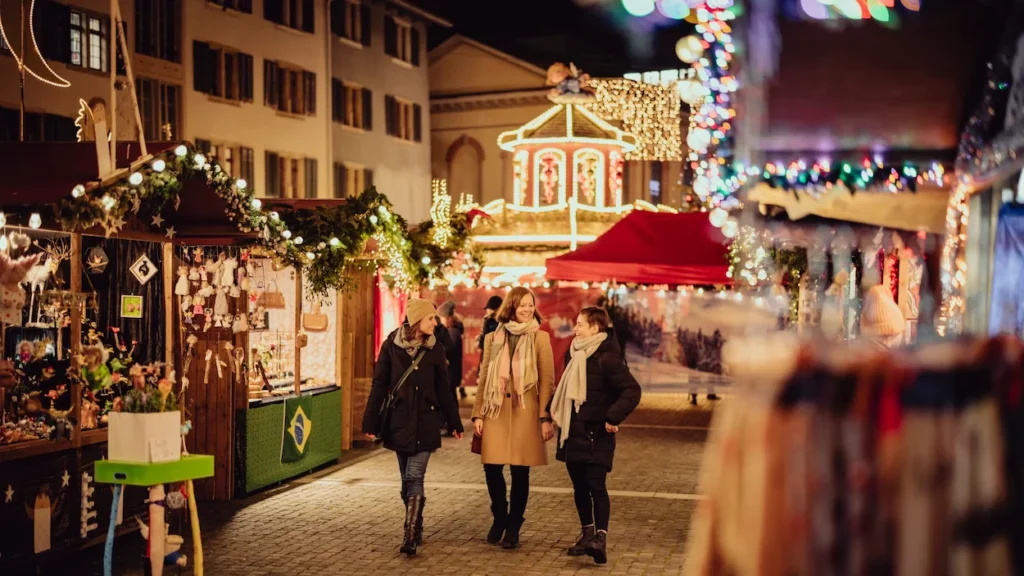
Bremgarten is a small medieval town in canton Aargau, about 40 minutes from Zurich by train, and its Christchindli-Märt is one of Switzerland’s biggest Christmas markets by stall count. Over 250 stalls fill the car-free old town from December 3 to 6, 2026, and around 100,000 people visit across those four days. This is its 31st year, and the fact that it draws those numbers to a town this size tells you something.
The old town is surrounded on three sides by the Reuss river, which keeps the whole layout contained and walkable despite the crowds. Go in the late afternoon when the lights come on and the medieval lanes are at their best. The food is market fare with raclette, spit roasts, and roasted almonds, and the mulled wine here has a local reputation. Horse-drawn carriage rides through the old town are available if you want to see it from a different angle.
Because it’s only four days, it gets busy, especially Friday and Saturday evenings. I’d aim for Thursday afternoon or Sunday morning for a calmer visit. If you’re driving, follow the event signs to the parking areas and take the shuttle into town.
Chur
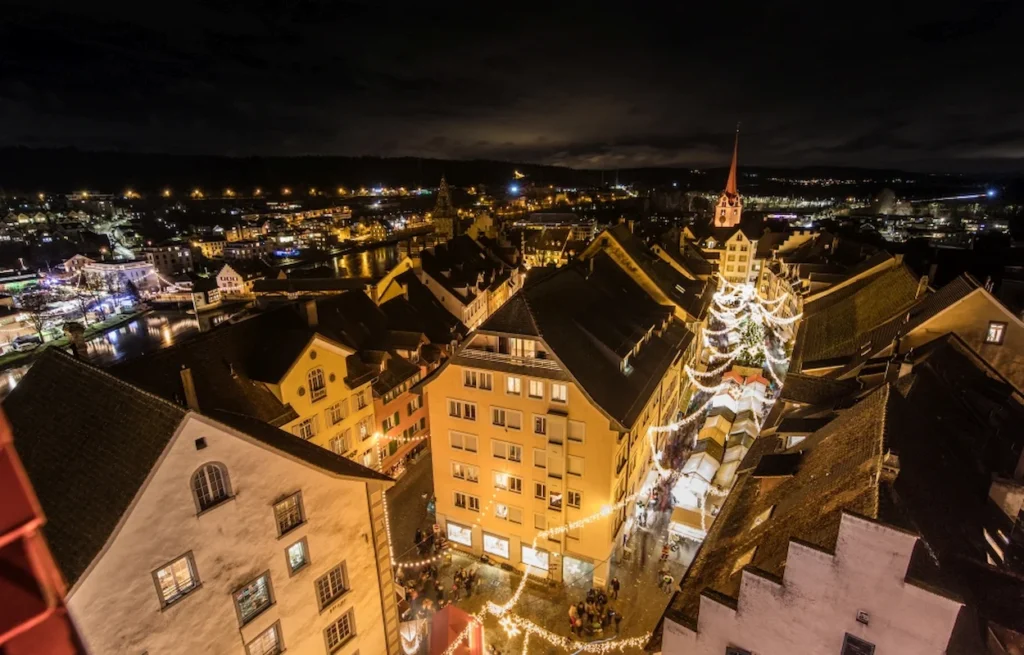
Chur is Switzerland’s oldest city and the old town looks the part in December. The main Christmas market in Chur is a weekend-only event held in late November (typically the last Friday and Saturday), when around 160 stalls fill the medieval lanes. It’s big for a single weekend and draws people from across the Graubünden region. The smaller Christkindlmarkt then picks up through Advent with a handful of stalls in the city center selling handmade gifts and local food, open daily until a few days before Christmas.
The food here is regional and specific to eastern Switzerland. Bündnerfleisch is the star, an air-dried beef similar to bresaola that you’ll find sliced thin at the market stalls. The Bündner Nusstorte, a dense caramelized walnut tart, is the thing to bring home as a gift. Barley soup is the classic warming meal here and you’ll see it on every food stand. It’s hearty and cheap and exactly what you want after walking around in the cold.
Chur is the starting point for both the Bernina Express and the Glacier Express. Combining a morning on one of those scenic trains with an afternoon at the market is a great December day out. You could also take the Rhaetian Railway up to Arosa for skiing or sledding and come back down in time for the evening stalls. It’s a two-hour train from Zurich.

Biel/Bienne
Biel/Bienne is Switzerland’s only officially bilingual city, French and German, and you’ll hear both switching back and forth as you walk through the market. It opens December 3 and goes through December 24, 2026, with around 80 stalls in the city center. For a place that doesn’t get the same attention as Zurich or Basel, it pulls over 500,000 visitors each season, and it has a warm, local feel that the bigger markets can lose in the crowds.
The standout here is the Canadian hut at the junction of Rue de Nidau and Rue Dufour. Here, forest workers serve mushroom risotto, wild boar sausage, and mulled wine heated over a wood fire. It’s the kind of stall you end up standing around for an hour because the food is good and the atmosphere is right. The craft vendors are mostly regional artisans selling handmade gifts, and because Biel/Bienne sits on the edge of the Jura watchmaking region, you’ll find some unique pieces you won’t see at other markets.
If the weather is clear, take the funicular up to Magglingen for sweeping views over Lake Biel. The lake is beautiful in winter even without snow, and the ride only takes a few minutes. Biel/Bienne is about 30 minutes from Bern by train, which makes it easy to combine with a visit to the Bern markets on the same day.

Thun
Thun is a smaller Christmas market that I’d recommend combining with a day trip from Bern (which is only 20 minutes away by train). It opens November 27 and goes through December 23, 2026, with stalls winding between Waisenhausplatz and Mühleplatz and Thun Castle lit up on the hill above. The pace here is noticeably slower than the bigger cities, and the crowd is mostly local.
Walk up to the castle before it gets dark. The view over Lake Thun and the Bernese Alps from the top is excellent in winter, and the museum inside takes about 30 minutes. Back down at the market, the Märit Beizli on Waisenhausplatz does good mulled wine and mulled cider, and the Thuner Chnöpfli (a local pasta dish) is the thing to eat when it’s cold.
On Mühleplatz they set up curling lanes in the evenings at CHF 80 per lane for up to eight people, which is a fun option if you’re visiting with a group. The old town’s covered walkways along Obere Hauptgasse have shops and restaurants on two levels and keep you dry if the weather turns. Thun also works well as a starting point for the Bernese Oberland if you’re planning mountain days alongside your market visits.

Geneva
Geneva’s main Christmas market has moved in recent years and is now on the Quai du Mont-Blanc lakefront, called Noël au Quai. Around 150 wooden chalets line the promenade with the Jet d’Eau and the Alps visible across the water. It’s open from November 19th until December 24th, 2026.
Being in the French-speaking part of Switzerland changes what you eat and drink here. The fondue is savoyarde-style, the street vendors do marrons chauds (hot chestnuts) everywhere, and the hot chocolate is made with Swiss couverture chocolate. It’s noticeably richer than what you’ll get at the German-speaking markets. Friday and Saturday evenings are when the market is at its best, staying open until 11pm with a busy, social atmosphere along the water.
The nearby borough of Carouge has its own smaller market with independent artisan stalls and a more neighborhood feel, and it’s a short tram ride from the center. Geneva is also probably the easiest Swiss city to fly into if you’re coming from abroad, and the airport is well connected to the city center by train. If you’re planning a Lake Geneva trip that includes Lausanne and Montreux, Geneva is the natural starting point.
- Read next: Best Activities on Lake Geneva

Zug
Zug is a quiet pick for a December day trip from Zurich, about 25 minutes by train. The main Christmas market at Burg Zug is a weekend event (December 12-13, 2026). The nearby Baar Christchindli-Märt on November 28, 2026 is a bigger affair with over 130 booths of gifts, crafts, and food that’s been going since 1981. Neither is on the scale of Basel or Bern, but that’s part of the appeal.
The thing to eat in Zug is the Zuger Kirschtorte, a layered cake made with nut meringue, butter cream, and kirschwasser cherry brandy. It was invented here in 1921 and has had some famous admirers over the years, including Audrey Hepburn and Charlie Chaplin. Pick one up at Treichler, the bakery that’s been making them since the original recipe, and eat it by the lake. If you visit on December 6, the Zuger Märlisunntig takes over the car-free old town for an afternoon of fairy tales and draws around 8,000 people.
The medieval old town is compact and the walk along Lake Zug in winter is lovely, especially with snow on the mountains across the water. You can take boat rides on the lake even in December. Combining Zug with a visit to Lucerne (30 minutes by train) makes for a full day out.
- Read next: Scenic Villages in the Alps


Global Viewpoint is a personal blog. All content is for informational and entertainment purposes only and does not constitute professional financial, medical, or legal advice.